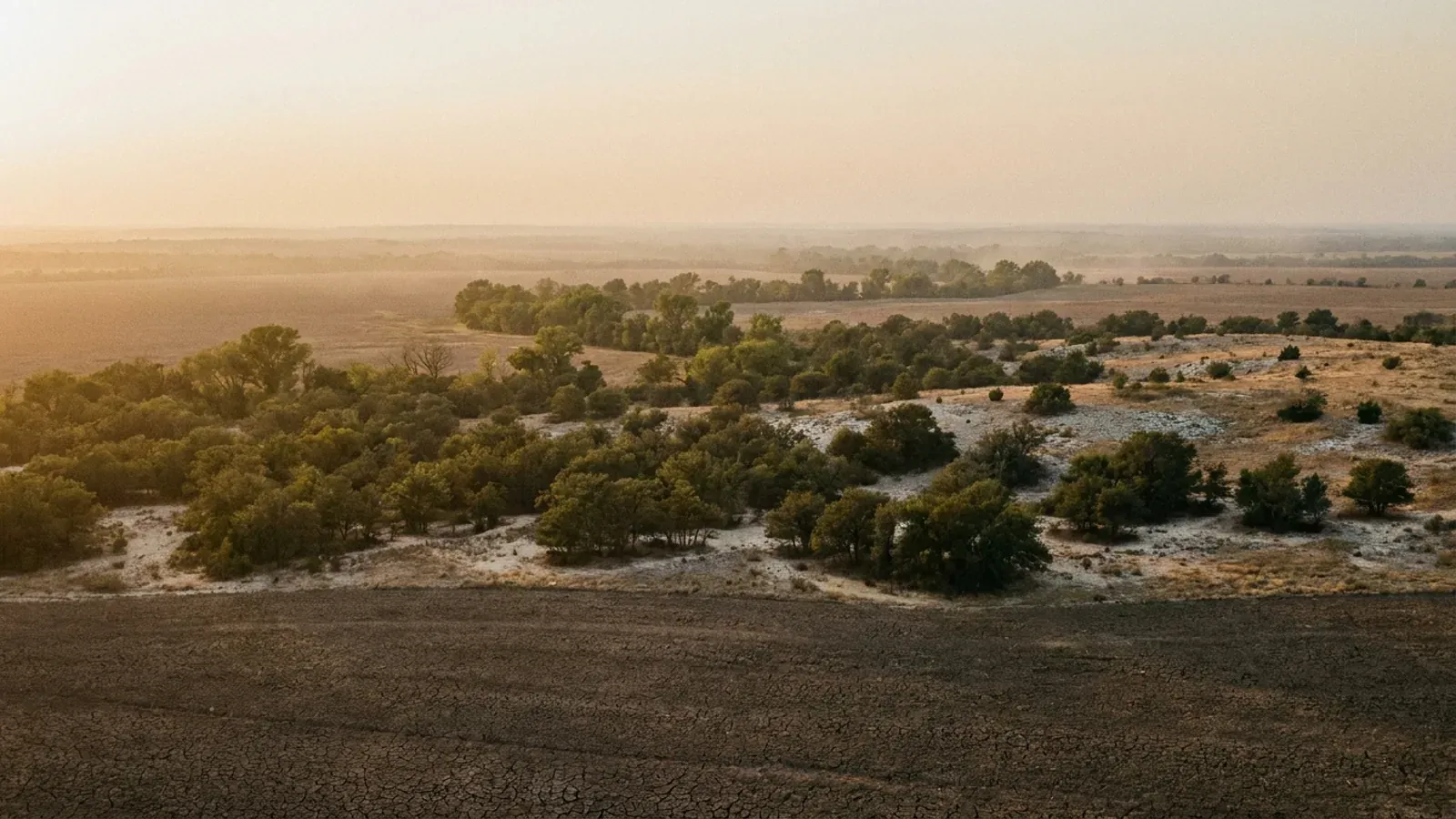
Open rolling Blackland Prairie cropland grading into a post oak belt of the Eastern Cross Timbers, with a pecan-lined creek.
McLennan County Builder's election: the IRC published as of 1 May 2008, or the version applicable in the City of Waco as adopted here

Barndominium Builders in McLennan County, TX

McLennan County is the county we work in day to day, and it is one of the few Texas counties that opted into Subchapter F of Local Government Code chapter 233. That opt-in is often misread. It creates no county building department: no permit, no fee, no inspector. What it does is oblige the builder to file a notice before starting, contract three inspections privately, and file a second notice afterwards. Only 16.4 percent of the county's residents live outside a city limit, and that share has barely moved in five years while Waco and the ring towns absorbed the growth. The acreage is out past them — China Spring, Crawford, Axtell, Riesel, West, Moody — on Blackland Prairie clay that puts a licensed engineer on the foundation. The permits that actually shape a build here are the septic permit, a floodplain determination, and a platting answer you need before either.

McLennan County at a glance

County
McLennan County
Population
272,020
Where we build
Waco, Bell County, Temple

ZIPs 76705, 76657, 76691, 76638, 76655, 76689, 76624, 76682 and more

Site visits
Site walks booked county-wide, Waco included

Building conditions in McLennan County

What actually changes from one Texas jurisdiction to the next: who issues the permit, whether the residential code is enforced there at all, what the structure has to be engineered to, and what the ground is like. These are the numbers your drawings have to satisfy.

Build conditions for McLennan County , Texas . BUILD CONDITIONS MCLENNAN COUNTY…McLennan CountyBUILDER'S ELECTIONADOPTED RESIDENTIAL CODEBUILDER'S ELECTIONThis jurisdiction publishes no design wind speed. It is settled in writing with the authority overyour parcel before the frame is ordered.ZONING · NONE — A TEXAS COUNTY CANNOT ZONE, A…State floors only: half an acre on a…Local Government Code section 233.153(d)(2), attached as an exhibitto the county's own order, does not authorise an opted-in…IMPACT AND PERMIT FEESCounty-published development feesMcLennan County charges nothing for a building permit because itissues none. What it does publish: a floodplain development permit…WHO ISSUES THE PERMITMcLennan County Engineer's Office215 N. 5th St., Suite 130, Waco, TX 76701; mailing address P.O. Box648, Waco, TX 76703. Engineering 254-757-5028, mapping 254-757-5067…
Build conditions for McLennan County, drawn from the sourced facts on this page. Every figure above is cited in the quick-facts panel below, with its source and vintage.
The county opted in — and it is an election, not a single code
Paragraph 4 of McLennan County's Subchapter F order reads that new residential construction in the unincorporated county must comply with "either the International Residential Code published as of May 1, 2008 or the version of the International Residential Code that is applicable within the City of Waco." That is a genuine choice, and paragraph 7 makes the builder declare which version will be used before work starts. The county's own summary page states it as a single mandatory rule; the order is the instrument, and the order says either or.

Order of the Commissioners Court of McLennan County, Texas Requiring the Application of Subchapter F of Chapter 233 of the Texas Local Government Code to New Residential Construction in Unincorporated McLennan County, adopted 13 October 2009 and revised 15 September 2020, paragraphs 4 and 7 — mclennan.gov/DocumentCenter/View/10988

No county permit, no county fee, no county inspector
The county states it plainly: "McLennan County does not have inspection authority or responsibility and can not charge fees." Instead the builder notifies the County Engineer's Office of the location, approximate completion date and code version, obtains three inspections — foundation before concrete, framing and mechanical before it is covered, and completion — and files a notice of those inspections within ten days of the final one. The builder contracts the inspectors from a closed list of six: a licensed engineer, a registered architect, a TREC-licensed professional inspector, a municipal plumbing inspector licensed by the state board, a building inspector employed by a political subdivision, or an ICC-certified residential combination inspector.

McLennan County Engineering, "Residential Building Requirements" — mclennan.gov/996/Residential-Building-Requirements; and the county's Subchapter F order, paragraphs 5, 6, 7 and 8

Every septic system needs a permit — on any size tract
Section 10 of McLennan County's on-site sewage facilities order is the county's own exhaustive list of rules stricter than the state's, and item (A) reads: "Permits shall be required for all On-Site Facilities regardless of lot size of acreage tract." The widespread belief that ten acres exempts a rural Texas tract from the septic rules dies here in the county's own text. TCEQ has said the same about the misreading of its own rule, which it amended in 2023 because the old wording "has been misinterpreted by homeowners, installers, authorized agents, and other stakeholders."

Order Adopting Rules of McLennan County, Texas for On-Site Sewage Facilities, Section 10(A); TCEQ preamble to the 2023 amendment of 30 TAC 285.3(f)(2) — mclennan.gov/DocumentCenter/View/591

A loft over the shop counts against your drainfield here
State rules size a septic system off living area, not total footprint, so a shop bay normally does not count. The Waco-McLennan County Public Health District, which is the county's designated representative for septic, publishes a stricter counting rule with its fee schedule: "All separate structures (e.g., loft, mini-apartments, etc.) or any other structures that can be used for living quarters, regardless of the time duration, or if attached to a garage, will be deemed a living structure." That lands squarely on the barndominium shape. A loft over the workshop, or living quarters attached to the garage, is counted in when the drainfield is sized.

Waco-McLennan County Public Health District, On-Site Sewage Facilities Program fee schedule — waco-texas.com/Departments/Health-District/Environmental-Health/On-Site-Sewage-Facilities-Program; 30 TAC 285.10 permits an authorised agent to adopt more stringent standards

You need a plat or a recorded affidavit before you can apply for septic
The county's Adopted Development Orders page carries a note most people never reach: "If the property owner desires to apply for a septic system in the future, the On-Site Sewage Facility (OSSF) office will require either a plat or affidavit as part of their application packet." An owner claiming one of the platting exemptions in Section 1.7 of the Subdivision Regulations must request an affidavit from the McLennan County Engineering Department, sign it before a notary, file it with the County Clerk and deliver a copy back to Engineering. Without a plat or that recorded affidavit, the septic application is not complete. This is the first thing to sort out on a rural tract, not the last.

McLennan County Engineering, "Adopted Development Orders" — mclennan.gov/304/Adopted-Development-Orders; McLennan County Subdivision Regulations Section 1.7, passed 1 April 2003

The floodplain paperwork runs even when you are not in the floodplain
Article 3 Section C of the county's Flood Damage Prevention Order says "A Floodplain Development Permit shall be required to ensure conformance with the provisions of this Order." The county's own permit form, revised 29 February 2024, has a Section 2 the Floodplain Administrator signs, reading "This project is determined to lie outside of the 100-year floodplain and thus is exempted from the County's Flood Damage Prevention Order." So the determination is made and signed by the county either way. The published fee is $10.00 per determination and $50.00 per variance request. Where a site is in the mapped floodplain, Article 5 Section B requires the lowest floor elevated one foot above the base flood elevation, certified by a registered engineer, architect or land surveyor.

Flood Damage Prevention Order, McLennan County, Texas, 23 September 2008, Articles 3 and 5; Floodplain Development Permit form rev. 2-29-2024; Floodplain Development Permit Fee Schedule — mclennan.gov/306/Floodplain-Information

Also worth knowing before you build in McLennan County

Only 16.4 percent of the county lives outside a city
McLennan County reached 272,020 people in 2025, up from 261,189 in 2020. Waco alone accounts for 147,788 of that. The balance of the county — everyone outside every city limit — is 44,741, and it grew by just 391 people in five years while the county as a whole added 10,831. Spread across a county of 1,036.7 square miles of land, that is genuinely open country: the growth went to Waco, Hewitt, Robinson and McGregor, and the acreage stayed where it was.

U.S. Census Bureau Vintage 2025 population estimates, co-est2025-alldata.csv and sub-est2025.csv (percentages computed on POPESTIMATE2020); 2025 Census Gazetteer county file for Texas

Blackland Prairie clay puts an engineer on the foundation
USDA-NRCS names Waco by name as inside Major Land Resource Area 86A, the northern Texas Blackland Prairie, whose soils are "characterized by their shrink-swell nature." The two flagship series, Houston Black and Branyon, are both Vertisols. Two independent rules land in the same place on that ground: Texas Occupations Code section 1001.056(c)(2) withdraws the exemption that would otherwise let a private dwelling's slab be designed without an engineer, and IRC R403.1.8 hands an expansive-soil foundation to IBC section 1808.6 at a plasticity index of 15 or more. On Blackland clay, a Texas house gets a Texas-licensed engineer on the foundation.

USDA-NRCS Land Resource Regions and Major Land Resource Areas, MLRA 86A; official soil series descriptions for Houston Black and Branyon; Texas Occupations Code 1001.056(c)(2); IRC R403.1.8

The county cannot zone, and it has not raised the septic acreage floors
Opting into Subchapter F gave McLennan County no zoning power: the county's own page states the law does not "authorize the adoption or enforcement of zoning regulations," tracking Local Government Code section 233.153(d)(2). Nor did the county raise the state minimum tract sizes for a septic system, which stay at half an acre on a public water supply and one acre on a private well under 30 TAC 285.4(a)(1). That is worth knowing by comparison: Grayson County requires 1.5 acres on a well, Parker one acre regardless of water source, and Grimes two acres. McLennan sets none of its own. Recorded deed restrictions do the work zoning does elsewhere.

McLennan County, "Residential Building Requirements"; Local Government Code 233.153(d)(2); 30 TAC 285.4(a)(1); McLennan County OSSF Order Section 10

Building it to rent changes your exposure, not your code
Some Texas counties route a rented house into a commercial permitting track with a different code entirely. McLennan does not — it has no commercial building programme and has never adopted a county fire code, though its population would let it. What does change is the defence. Section 233.157(c), attached to the county's own order, shields an individual from the Class C misdemeanour for missing notices only if two things are true: they built it themselves or acted as their own contractor, and they "intend to use the residence as the individual's primary residence." Build the same barndominium to let, and the second limb fails.

Local Government Code 233.157(c), reproduced as an exhibit to the McLennan County Subchapter F order; McLennan County's published regulatory instruments, mclennan.gov

The septic office is not the county — and it reaches into towns too
Section 11 of the county's OSSF order declares the Waco-McLennan County Public Health District the designated representative for septic. Section 6 sets its reach: the rules apply to all the unincorporated areas of the county, and "shall also govern within the incorporated areas of cities or towns which have elected to be members of the Waco-McLennan County Public Health District." TCEQ's own authorised-agent register records the McLennan agent as serving the entire county. Published fees include $510 for a single-family non-aerobic system, $100 more for an aerobic unit, $200 for a reinspection, $20 a year for the mandatory aerobic maintenance contract, and a $10 state Research Council fee on every permit.

McLennan County OSSF Order Sections 6, 11 and 12; TCEQ authorised agent search, McLennan county code 155; City of Waco Health District OSSF fee schedule

A culvert is a county inspection with teeth
Access off a county road runs through the McLennan County Engineering Department, which visits the property, inspects the location and determines the pipe size needed for drainage before quoting the installation. An owner may supply and install their own culvert, but the county's published warning is direct: "If the pipe is not sized properly, or if the culvert system is installed incorrectly, the County may require you to remove the culvert and correct the installation per the County specifications at your expense." It is not a code review and no plans are examined — but it is a real county gate on getting a truck to the build site.

McLennan County Engineering, "Culvert Orders" — mclennan.gov/995/Culvert-Orders
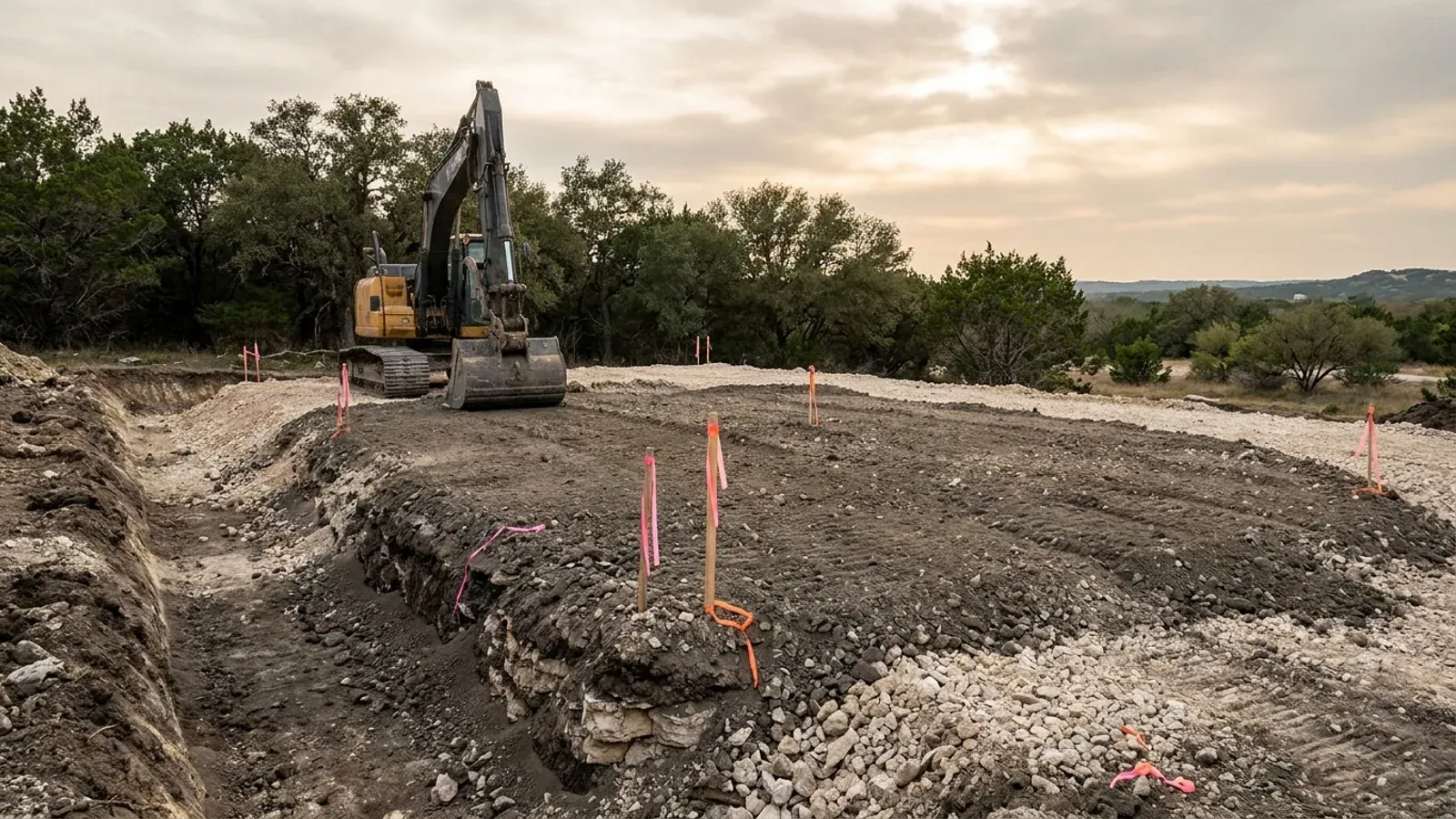
An excavator grading a compacted building pad on a cleared lot, with survey stakes and a drainage swale visible.
Below the slab

The expensive surprises are in the ground, not the building

What moves a Texas budget is usually below grade, and it is soil rather than rock: shrink-swell clay. The Blackland Prairie and the Gulf Coast clays move enough between a wet season and a dry one to drive the foundation design across the state's largest markets, which is why several DFW cities require an engineer's seal on the foundation of every new house. Those are the same conditions that decide whether a septic field passes its soil and site evaluation, so the grading plan, the foundation and the drainfield get resolved together rather than one at a time. We price the dirt before we price the building.

What we build in McLennan County

All nine of our services — kits, custom plans, post-frame and steel construction, site preparation, permitting and engineering, through to turnkey builds — are available across McLennan County. What a project costs depends far more on the parcel than on square footage, so we work from your land rather than from a rate card.

See what we build

What a build looks like

Three stages every McLennan County project passes through, from a raw parcel to a finished home. Site work first, because that is where the budget is decided.
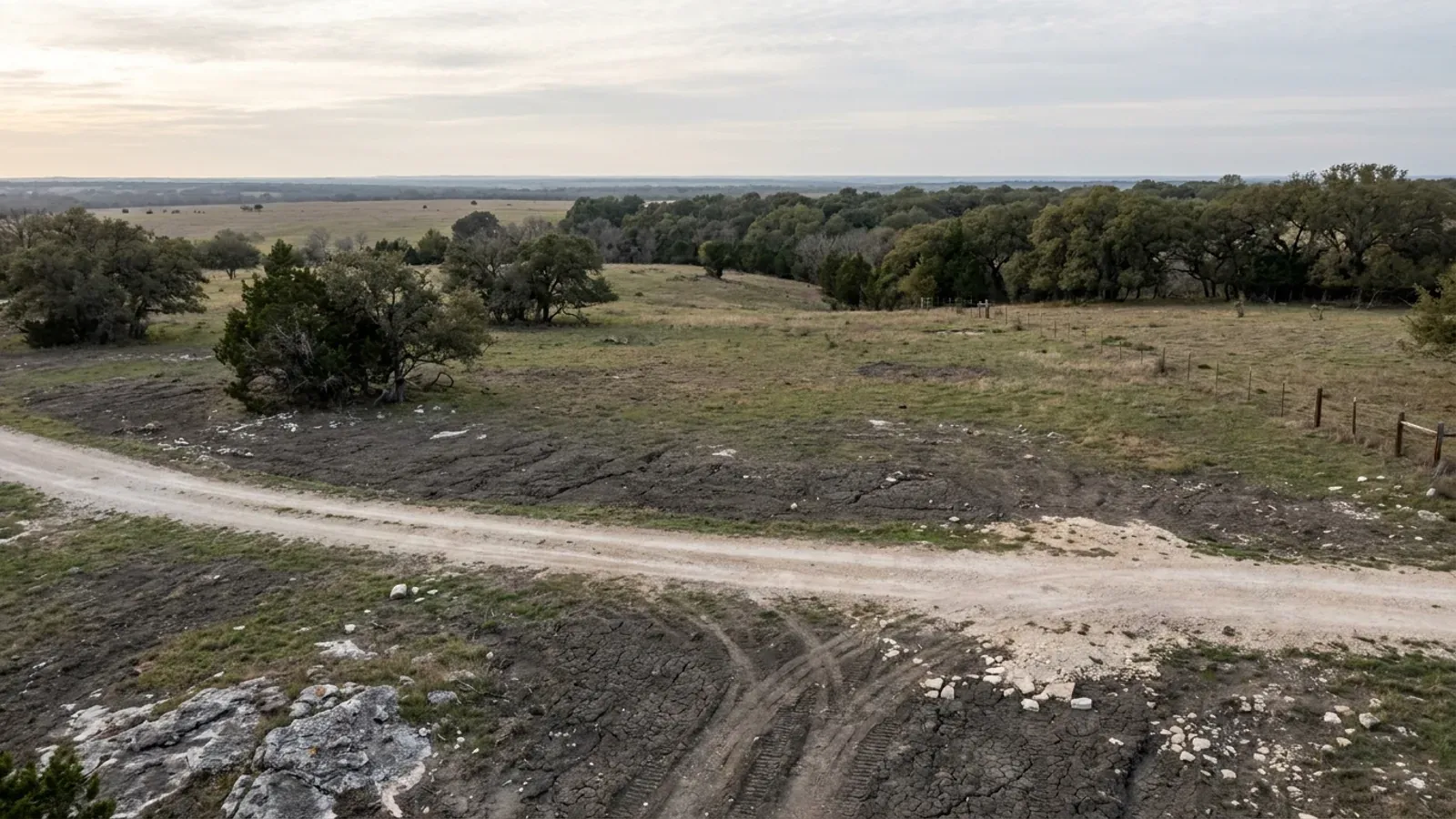
Aerial view of an undeveloped rural lot with cleared grass, a live oak and cedar elm treeline, and a pale gravel access track.
Stage one

The parcel

Zoning, setbacks, flood zone and utility access get checked before anything is drawn.

An excavator grading a compacted building pad on a cleared lot, with survey stakes and a drainage swale visible.
Stage two

Pad and permit

Clearing, grading and a compacted pad, while the submittal works through McLennan County.
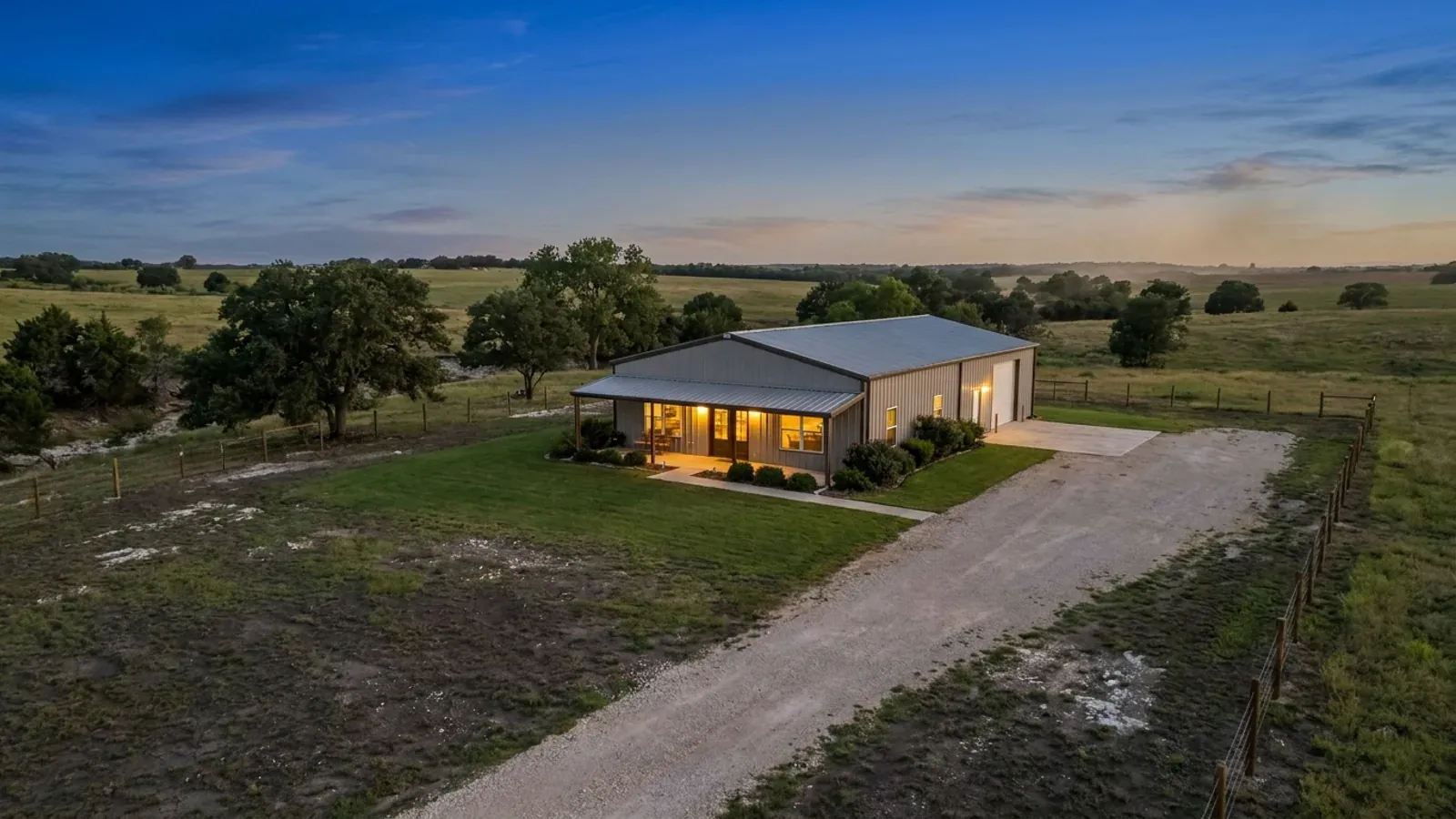
A finished barndominium at dusk with warm interior lighting glowing through its large windows.
Stage three

Frame to finish

Shell erected and dried in, then systems, insulation and interior finish through to CO.

Those are the rules for McLennan County. Tell us what you want to build and we will draw it to them.

Where we build around McLennan County

McLennan County and the rural land around it. The buildable acreage for a project this size usually sits outside the city limits, which is frequently what changes who issues your permit.

Our McLennan County service area, covering McLennan County and the surrounding rural acreage. This map marks the territory we serve, not a branch location.

Nearby areas we build in

Others we cover in this part of Texas. The permitting authority, the adopted design criteria and the zoning can all differ from one to the next.

Building in McLennan County: common questions

8 questions we get asked most often about building in McLennan County. If yours is not on the list, ask it directly.

Does McLennan County require a building permit for a barndominium?
No. McLennan County issues no building permit and charges no building fee, and it says so itself: "McLennan County does not have inspection authority or responsibility and can not charge fees." What it does have is a Subchapter F order, adopted 13 October 2009 and revised 15 September 2020, and that order shifts the work onto the builder. Before starting, the builder files a Notice of Residential Construction with the County Engineer's Office giving the location, the approximate commencement date and which code version will be used. During construction, three inspections must happen: at the foundation stage before concrete is placed, at the framing and mechanical stage before it is covered, and at completion. The builder contracts those inspections privately, from a closed list of six qualified people. Within ten days of the final inspection, a second notice goes to the county and to the person the home is being built for. Failing to file is a Class C misdemeanour under section 233.157. Inside Waco, Hewitt, Robinson, Bellmead, Woodway or any other incorporated city, none of this applies — that city's own building department and adopted code do.
Which building code applies in unincorporated McLennan County?
The order gives the builder a choice, and this is widely got wrong. Paragraph 4 reads that new residential construction must comply with "either the International Residential Code published as of May 1, 2008 or the version of the International Residential Code that is applicable within the City of Waco." Paragraph 7 confirms the choice is real by requiring the builder to state in advance which version will be used. The 1 May 2008 date corresponds to the 2006 edition. Waco's version is the 2024 IRC, adopted by Ordinance No. 2025-813 on 4 November 2025, with the energy chapter held at the 2018 edition and a clause that takes in newer ICC editions twelve months after publication. The county's own summary page states the rule more narrowly than the order does; the order is the recorded instrument and it says either or. One thing the order does not settle: it says "the version applicable within the City of Waco," not "as amended by the City of Waco," so whether Waco's own deletions from the code travel into the unincorporated county is an open question worth asking the County Engineer's Office at 254-757-5028 before you rely on either answer.
Does the workshop half of my barndominium make the septic system bigger here?
In McLennan County it can, and this is one of the few places in Texas where the answer differs from the state rule. TCEQ sizes a system off living area, not total footprint, so a 4,000 square foot building with 1,800 square feet of three-bedroom living space and a 2,200 square foot shop is normally rated as a three-bedroom house. But an authorised agent may adopt stricter standards, and ours has. The Waco-McLennan County Public Health District publishes this with its fee schedule: "All separate structures (e.g., loft, mini-apartments, etc.) or any other structures that can be used for living quarters, regardless of the time duration, or if attached to a garage, will be deemed a living structure." A loft over the shop, a mini-apartment above the workshop, or living quarters attached to the garage is counted in. That matters more here than it would elsewhere, because Blackland Prairie clay carries the lowest loading rate of any Texas soil class, so every extra gallon per day buys a disproportionately large drainfield. Worth noting: this counting rule is the Health District's published practice as the designated representative, not a clause in the Commissioners Court's own septic order, whose Section 10 stringency list contains only the permit rule and the aerobic maintenance rules. And there is no percolation test in Texas at all — soil is classified by texture.
I have more than ten acres. Am I exempt from the septic rules?
No, and McLennan County has said so in its own order for longer than most counties. Section 10(A) of the county's on-site sewage facilities order is unambiguous: "Permits shall be required for all On-Site Facilities regardless of lot size of acreage tract." The predecessor order carried the same rule. TCEQ has separately said the ten-acre belief comes from a misreading of its own former wording, which it amended in 2023 because it "has been misinterpreted by homeowners, installers, authorized agents, and other stakeholders." Ten acres is a different thing entirely in the platting rules, where Section 1.7(A)(3) of the county's Subdivision Regulations does exempt a division where all lots exceed ten acres — but Section 1.7(C) says that exemption "does not exempt the developer or owner of the property from requirements arising under McLennan County's floodplain development and/or on-site sewage facilities orders." Two different ten-acre rules, and only one of them is real relief.
What is the first thing I should do on a rural McLennan County tract?
Settle the platting question, because it gates the septic application. The county's Adopted Development Orders page states it directly: "If the property owner desires to apply for a septic system in the future, the On-Site Sewage Facility (OSSF) office will require either a plat or affidavit as part of their application packet." If your tract falls under one of the platting exemptions in Section 1.7 of the Subdivision Regulations — agricultural or wildlife use, four or fewer parcels transferred to close family, all lots over ten acres, and several others — you must request an affidavit from the McLennan County Engineering Department, sign it before a notary, file it with the County Clerk, and deliver a copy back to Engineering. If you would rather not, a plat is required instead. Do that first, before design money moves. While you are there, ask about the floodplain determination, which is $10 and gets signed either way, and about a culvert if the site needs access off a county road. Engineering is at 215 N. 5th St., Suite 130 in Waco, 254-757-5028, Monday to Friday 8 to 5.
Does it change anything if I build the barndominium to rent out?
In McLennan County the code does not change, but your exposure does. Some Texas counties route a rented house into a commercial permitting track under a different code and a fire marshal; McLennan has no commercial building programme and has never adopted a county fire code, even though its population of 272,020 would permit one under section 233.061. So a let barndominium is under the same Subchapter F obligations as one you live in. What changes is the defence. Section 233.157(c), attached as an exhibit to the county's own order, protects an individual from the Class C misdemeanour for failing to give proper notice only where both of two things hold: the construction is built by that individual or they act as their own contractor, and they "intend to use the residence as the individual's primary residence." An owner-builder putting up their own home is covered. The same owner-builder putting up the identical building to let is not, because the second limb fails. If a rental or a guest let is anywhere in your plan, the notices and the three inspections are not optional housekeeping.
Is there zoning in unincorporated McLennan County, and what actually restricts what I can build?
There is no zoning, and opting into Subchapter F did not create any. The county states it on its own page: the law does not "authorize the adoption or enforcement of zoning regulations," which tracks Local Government Code section 233.153(d)(2). McLennan County also has not raised the state's minimum tract sizes for a septic system, which stay at half an acre on a public water supply and one acre on a private well — a real difference from Grayson at 1.5 acres on a well, Parker at one acre regardless, and Grimes at two. What does bind is private: recorded deed restrictions, which Texas courts enforce, and which routinely control metal exteriors, minimum square footage, roof pitch, outbuildings and whether a shop may be built before a house. They are recorded with the County Clerk and they are the single most common reason a barndominium plan has to change on land where there is no public code at all. Read the restrictions on the deed before you buy, not after.
How much of the county is actually open land?
Most of the area, very little of the population. McLennan County covers 1,036.7 square miles and reached 272,020 people in 2025. Waco alone is 147,788 of those, and the ring towns — Hewitt, Robinson, Bellmead, Woodway, Lacy-Lakeview, McGregor — take most of the rest. Everyone outside every city limit adds up to 44,741 people, or 16.4 percent of the county, and that number grew by just 391 in five years while the county added 10,831. So the growth is going into the cities and the land is staying where it is. By area, the largest rural pockets are around China Spring, the northeast county out past Bellmead, West, Crawford, Lorena, Valley Mills, Axtell, Moody and Riesel. That is a different picture from the big metro counties, where a large unincorporated population usually means master-planned subdivision rather than acreage.

Building in McLennan County?

Start with the plan. Tell us what you want to build and we will draw it, then confirm what McLennan County will actually let you put on the parcel and what wind load it has to meet. That conversation costs nothing.