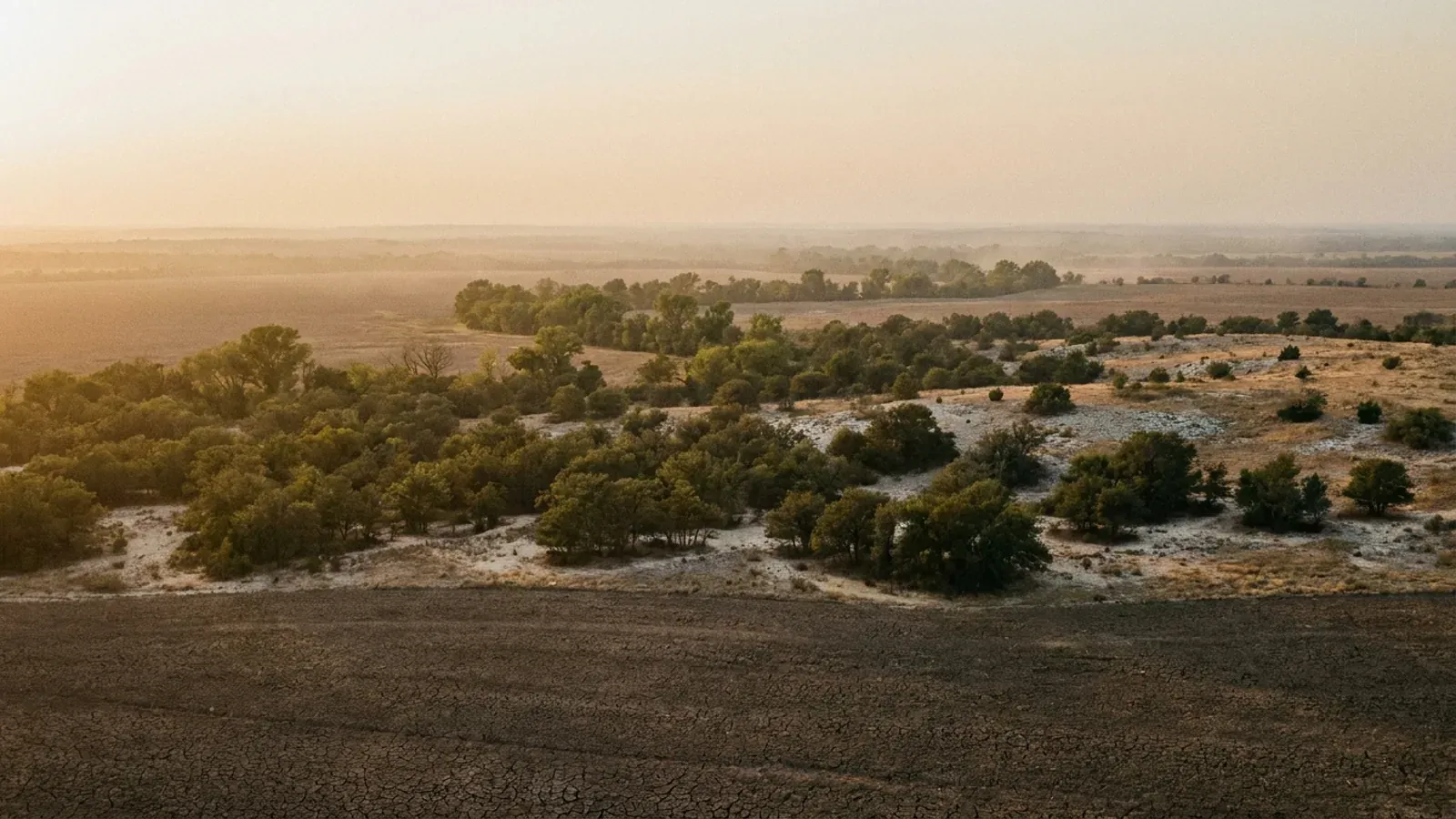
Barndominium Builders in Bell County, TX
Bell County is 1,054 square miles between Belton Lake and the Little River bottoms, and the answer to what applies here changes at every city line. Outside them the county's own engineer puts it plainly: no building permit, no building code, no zoning. What does apply is a different list. The septic permit is the one that looks hardest at the house, and Bell County requires it on any size tract. Every septic application carries a floodplain certificate to the county engineer. On rural acreage the binding constraint is usually water rather than dirt, because the Clearwater Underground Water Conservation District permits wells across the whole county and the county's own sewage order then adopts the district's minimum lot size. Inside Killeen, Temple, Belton, Harker Heights, Salado, Nolanville or Troy, that city's adopted code and its own building official apply instead.
Bell County at a glance
- County
- Bell County
- Population
- 402,248
- Where we build
- Belton, Temple, Killeen
- Site visits
- We meet you on the tract, Belton or anywhere else in Bell County
ZIPs 76513, 76501, 76502, 76504, 76511, 76519, 76527, 76528 and more
Building conditions in Bell County
What actually changes from one Texas jurisdiction to the next: who issues the permit, whether the residential code is enforced there at all, what the structure has to be engineered to, and what the ground is like. These are the numbers your drawings have to satisfy.
Bell County Engineer, Land Development FAQ, bellcountytx.com/departments/engineer/faq.php
Clearwater Underground Water Conservation District Rules 6.3 and 9.5.5, effective 26 August 2026
Bell County Public Health District, Additional Rules beyond Chapter 285, Rule 3
Bell County Public Health District Additional Rules beyond Chapter 285 and its Application to Construct OSSF; TCEQ form TCEQ-0235 item 8 and 30 TAC Ch. 285 Table II; Waco-McLennan County Public Health District OSSF order
Bell County Subdivision Regulations adopted 2 April 2001, revised 2 December 2024, Appendix D, Bell County Engineer Services & Fee Schedule
Texas Local Government Code Secs. 241.003, 241.011 and 241.014; City of Harker Heights Code ch. 97 subch. I, Ords. 87-28 and 88-13; City of Killeen Code ch. 7 art. III, Ord. 88-27
Also worth knowing before you build in Bell County
- Ten acres buys you nothing on septic
- The widespread belief that ten acres exempts a house from the septic rules is wrong statewide, and Bell County forecloses it in its own words twice over. Its additional rules require that all construction of, alteration, extension or repair to on-site sewage facilities be permitted and inspected, regardless of the size of the tract of land. Its Health District page says the same in plainer English: Bell County requires all OSSFs to be permitted regardless of lot size or acreage.
- The drainfield decides where the shop goes
- Bell County publishes a setback the state rules leave to a table: no subsurface disposal system may be installed within five feet of a home or building's foundation slab. On a barndominium that is planned as one long slab with a shop bay on the end, the septic layout is settled before the building footprint is, not after. The same rules bar holding tanks for new construction outright, allowing a septic tank as a temporary holding tank for no more than sixty days.
- The affidavit is filed before the application, not with it
- Since 1 September 2024 all affidavits must be filed with the Bell County Clerk's Office before the septic application is submitted, and a copy of the filed affidavit must be attached to the initial application. An application submitted without it is rejected and the whole packet has to be resubmitted in full. The clerk requires original wet-ink legible affidavits at 1201 Huey Road, Belton, and charges a $10 filing fee.
- What the septic permit costs
- Bell County publishes $610 for a standard single-family residential on-site sewage permit and $710 where the design is a professional one, with a $150 initial design review that is applied to the permit fee but must be paid before review starts. Additional design reviews are $150, an amended design $300, a real estate inspection $200, and an unpermitted installation is charged at twice the current permit fee.
- An agricultural exemption from platting is conditional, not spent
- Bell County requires a plat wherever a resulting tract is ten acres or less, with exemptions for agricultural use, conveyances to close family, lots all over ten acres and sales to veterans through the Veterans' Land Board. The trap is in the next line: if the tract ceases to meet the exemption, platting requirements shall immediately apply. Buy a small ag-exempt carve-out, stop farming it, and the obligation attaches. Each platted lot also needs 50 feet of frontage on a public road.
- The county does set building setback lines
- Bell County has never adopted a residential building code, but it has used a different part of the same chapter. Its subdivision regulations set building setback lines in accordance with Chapter 233 of the Local Government Code: fifty feet from the edge of the right of way on major highways and roads, twenty-five feet on other public roads, and fifteen feet in the turnaround of a cul-de-sac. Those lines are drawn on the plat.
- Every septic application gets a floodplain check
- The county engineer explains the link himself: when you apply for an on-site sewage permit from the Health District you are asked to fill out a Flood Plain Exemption Certificate, and that certificate goes to the County Engineer's Office for review to ensure you are not building in the flood plain. The County Engineer is the county's designated floodplain administrator, and on a platted lot in a flood hazard area the minimum first floor must be set at least one foot above the floodplain elevation, with no structures permitted in an identified floodway.
- Let it by the weekend and the county has a form for you
- There is no county building code for a house you rent out here, but there is a tax. Bell County levies a hotel occupancy tax of 2 percent of taxable receipts on anyone owning, operating, managing or controlling a hotel, motel, tourist home, lodging house, inn, rooming house or bed and breakfast in the county, and it expressly excludes permanent residences of longer than 30 days. A monthly report is due by the 20th even when no tax is owed.
- A foster home or a day care is inspected, in the unincorporated county
- The Bell County Fire Marshal's Office conducts fire and life safety inspections and witness tests throughout the unincorporated areas of the county and in some smaller municipalities, and publishes fees for them: foster or adoptive homes $75, day care centres $75, licensed facilities $60, nursing homes $150, plan review $50 and a construction final certificate of occupancy $50. Since 1 January 2025 it all runs through the My Government Online portal. So a change of use can put a county inspection on a building that needed no permit to build.
- This is Blackland Prairie, and the soil series is named for the county
- The Branyon series, one of the two flagship soils of the Texas Blackland Prairies, was established in Bell County in 1972 and is classified as a Udic Haplustert, a Vertisol, the soil order defined by shrink-swell cracking clay. The NRCS regional soil survey office responsible for it is in Temple. That matters because Texas removes the exemption that otherwise lets a residential slab be designed without an engineer once the soil is expansive.
- The Edwards Aquifer permit does not reach here
- In the Hill Country counties an hour south, building over the Edwards Aquifer recharge zone brings a TCEQ approval onto land that has no building code at all. Bell County is outside that programme. TCEQ's own guidance describes the recharge zone construction restrictions as applying in Williamson, Travis, Hays, Comal, Bexar, Medina, Uvalde and Kinney counties. Bell is not among them, even though the Edwards Balcones Fault Zone aquifer underlies part of the county.
- Climate zone 2A, and the edition does not change it
- Bell County is climate zone 2A, hot-humid, on the pre-2021 map and on the 2021 and 2024 map alike. It is not one of the eight Texas counties whose insulation specification depends on which edition a jurisdiction happened to adopt, so the zone is the same in Killeen, Temple, Belton and out on the county roads between them.
- A licensed plumber is required even where nothing else is
- The rural exemption in the Texas plumbing licence law expressly excludes plumbing performed in conjunction with new construction. It is one of two statewide requirements that survive the absence of a county building code, and it applies on land with no permit and no inspector. The other is the state energy code: a builder working outside the limits of any municipality must certify the house against it and keep that certification for three years.
- Most of Bell County's people are inside a city, and the share is falling
- Bell County's population estimate rose from 372,407 on 1 July 2020 to 402,248 on 1 July 2025, a gain of 8.0 percent. But the balance of the county, everyone outside every city limit, fell over the same period from 59,112 to 56,910, because Killeen, Temple, Belton, Nolanville and Troy have been annexing outward. The land is still there across 1,054 square miles, but the buildable private acreage sits east and south of the reservation rather than in the Killeen corridor.
Bell County Public Health District, Additional Rules beyond Chapter 285, Rule 1, and its OSSF Process page
Bell County Public Health District, Additional Rules beyond Chapter 285, Rules 12 and 13
Bell County Public Health District, On-Site Sewage Facilities page, New Affidavit Procedures starting 1 September 2024
Bell County Public Health District, On-Site Sewage Fees, May 2024 revision, effective 1 September 2024
Bell County Subdivision Regulations revised 2 December 2024, Sec. 103.1 and Appendix A items 5, 6 and 8
Bell County Subdivision Regulations revised 2 December 2024, Sec. 301.1
Bell County Engineer Land Development FAQ and Floodplain Management page; Bell County Subdivision Regulations revised 2 December 2024, Sec. 204(14)
Bell County Hotel Occupancy Tax Order 291/15, rate effective 1 October 2015, Bell County Auditor's Office
Bell County Fire Marshal's Office, Application for Service & Fee Schedule and Online Permits pages
USDA-NRCS Official Series Description, BRANYON, soilseries.sc.egov.usda.gov; Texas Occupations Code Sec. 1001.056(c)(2); IRC R403.1.8 and IBC Sec. 1808.6
TCEQ Edwards Aquifer Protection Program, Rules page, describing RG-011
DOE/PNNL-33270 climate zone assignments and the published IRC county tables for the 2018 and 2024 editions
Texas Occupations Code Sec. 1301.052; Texas Health and Safety Code Secs. 388.003(a) and 388.004
U.S. Census Bureau county and subcounty population estimates, co-est2025-alldata and sub-est2025, computed on POPESTIMATE2020; 2024 Census Gazetteer county file
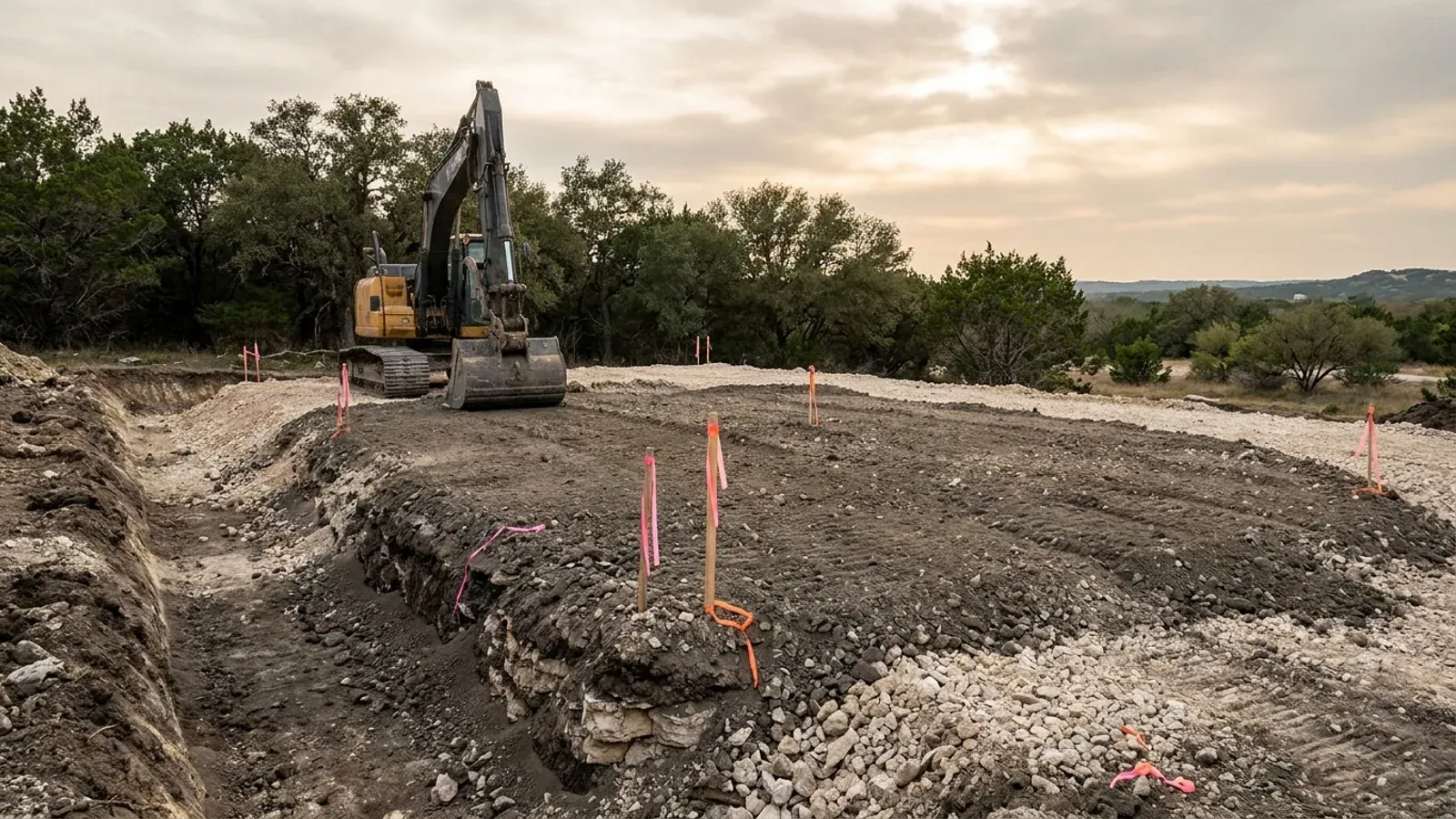
The expensive surprises are in the ground, not the building
What moves a Texas budget is usually below grade, and it is soil rather than rock: shrink-swell clay. The Blackland Prairie and the Gulf Coast clays move enough between a wet season and a dry one to drive the foundation design across the state's largest markets, which is why several DFW cities require an engineer's seal on the foundation of every new house. Those are the same conditions that decide whether a septic field passes its soil and site evaluation, so the grading plan, the foundation and the drainfield get resolved together rather than one at a time. We price the dirt before we price the building.
What we build in Bell County
All nine of our services — kits, custom plans, post-frame and steel construction, site preparation, permitting and engineering, through to turnkey builds — are available across Bell County. What a project costs depends far more on the parcel than on square footage, so we work from your land rather than from a rate card.
See what we buildWhat a build looks like
Three stages every Bell County project passes through, from a raw parcel to a finished home. Site work first, because that is where the budget is decided.
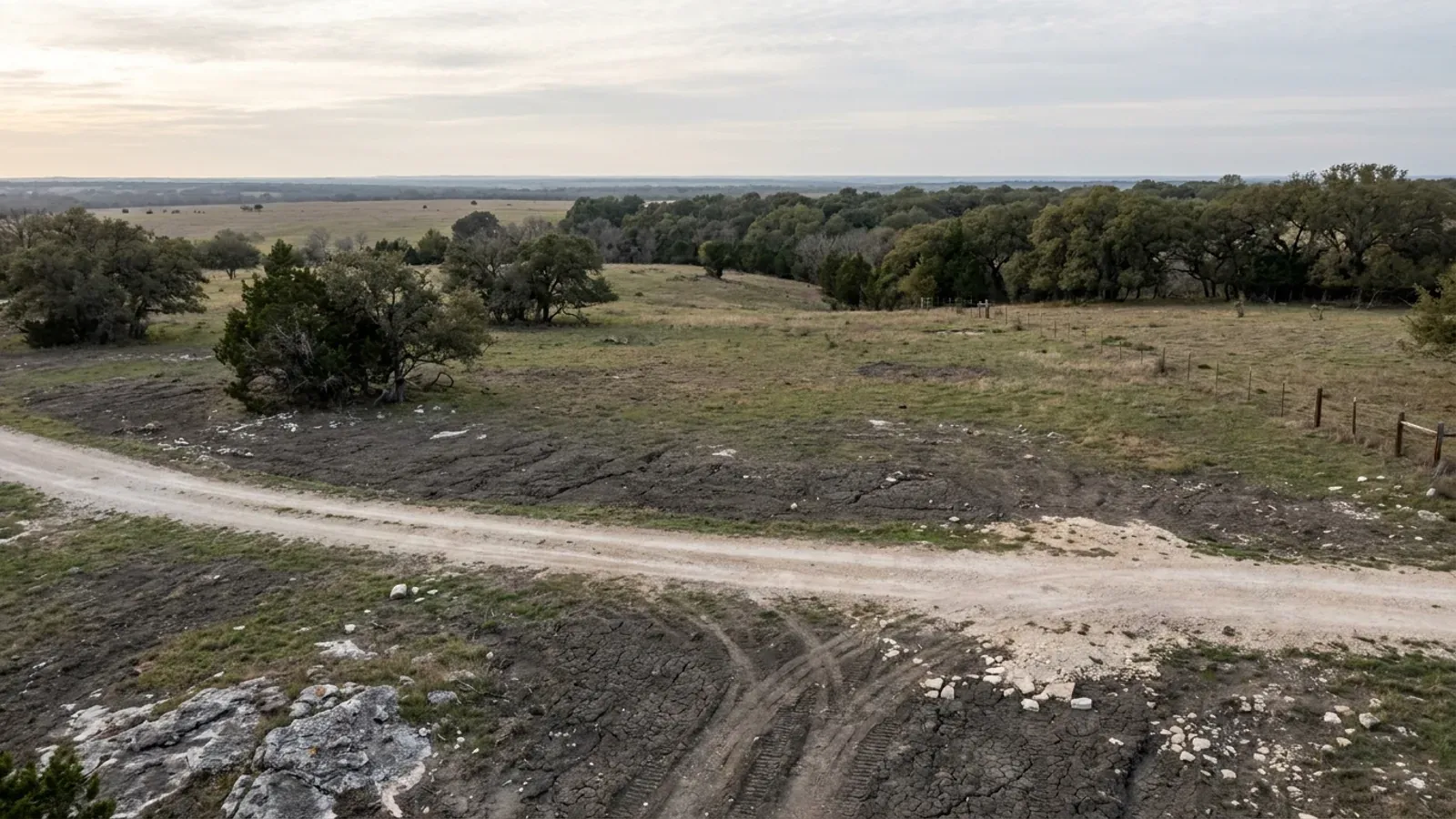
The parcel
Zoning, setbacks, flood zone and utility access get checked before anything is drawn.
Pad and permit
Clearing, grading and a compacted pad, while the submittal works through Bell County.
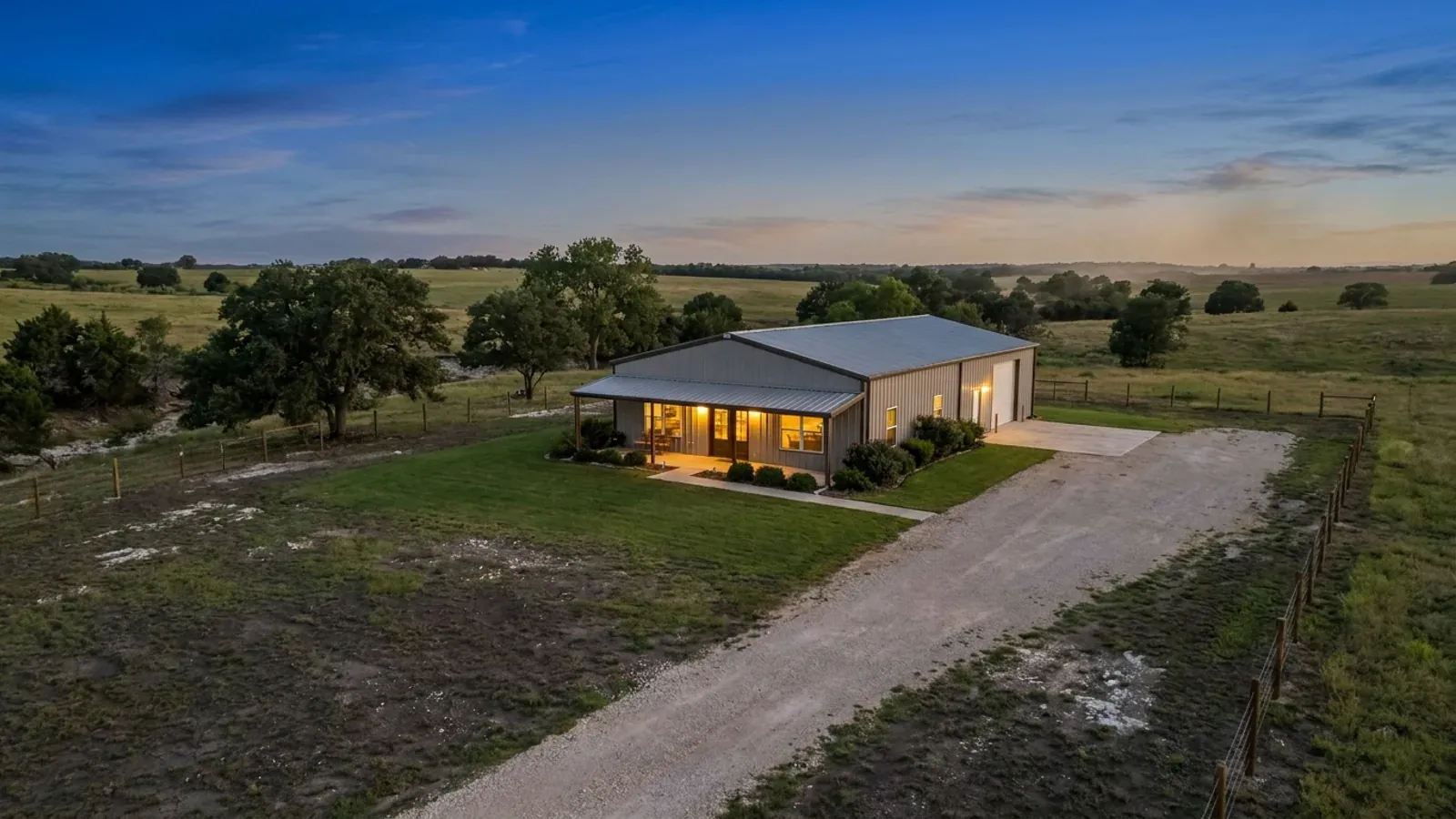
Frame to finish
Shell erected and dried in, then systems, insulation and interior finish through to CO.
Those are the rules for Bell County. Tell us what you want to build and we will draw it to them.
Where we build around Bell County
Bell County and the rural land around it. The buildable acreage for a project this size usually sits outside the city limits, which is frequently what changes who issues your permit.
Keep reading
The questions that usually come next once you know what Bell County allows.
Barndominium Cost Guide
Sourced per-square-foot ranges by tier and by size, with a calculator built on the same figures.
Read itIs It Legal in Texas?
Classification, zoning, the HOA gate, and why "nonresidential farm building" does not cover a home.
Read itHow Long Does It Take?
Census build-duration data, and what actually sets the permit clock where you are building.
Read itNearby areas we build in
Others we cover in this part of Texas. The permitting authority, the adopted design criteria and the zoning can all differ from one to the next.
Building in Bell County: common questions
8 questions we get asked most often about building in Bell County. If yours is not on the list, ask it directly.
Do I need a building permit for a barndominium on unincorporated land in Bell County?
I found five acres near Salado with no water on it. What do I check first?
Does my shop bay make the septic system bigger?
I am at Fort Cavazos and looking at land nearby. Is there anything around the post I would not think to check?
I want to rent it out, or let it while I am posted elsewhere. Does that change anything?
How much does the county actually charge, if there is no building permit?
Everyone says rural Texas has no rules. Is that right here?
Is there a percolation test?
Building in Bell County?
Start with the plan. Tell us what you want to build and we will draw it, then confirm what Bell County will actually let you put on the parcel and what wind load it has to meet. That conversation costs nothing.