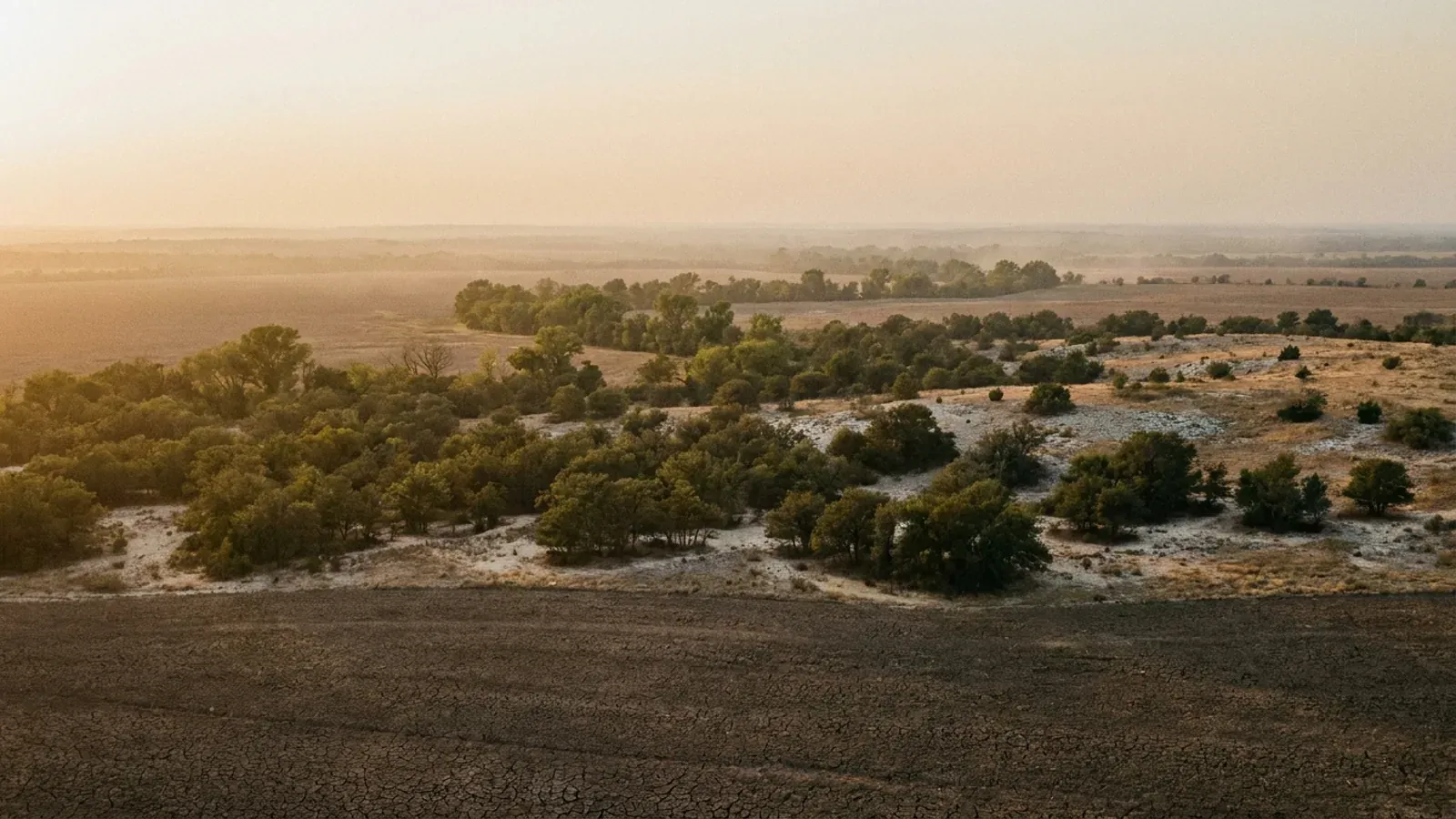
Open rolling Blackland Prairie cropland grading into a post oak belt of the Eastern Cross Timbers, with a pecan-lined creek.
Williamson County 2024 IRC as adopted here

Barndominium Builders in Round Rock, TX

Round Rock deserves a straight answer rather than a hopeful one. The city grew 17.2 percent between 2020 and 2025, but it grew by apartments, PUD subdivisions and a resort, not by acreage, and it holds 141,282 people on 38.1 square miles. The zoning ordinance settles it. Only two residential districts here have a minimum lot measured in acres: AG at ten and SF-R at two. The next largest is the one the city itself calls Large Lot, SF-1, at ten thousand square feet, under a quarter of an acre. When the city's planners counted the map in January 2020, AG covered zero acres and SF-R fifty-eight. Outside AG an accessory building is capped at fifteen feet, shorter than most shop doors want to be. If you already own a lot here, the code, fees and review clock below are worth knowing. If you are still buying land, look to unincorporated Williamson County, Georgetown's edges, or Burnet County.

Round Rock at a glance

County
Williamson County
Population
141,282
Where we build
Round Rock, Georgetown, Williamson County, Austin

ZIPs 78664, 78665, 78681

Site visits
On-site visits across Round Rock and the wider Williamson County

Building conditions in Round Rock

What actually changes from one Texas jurisdiction to the next: who issues the permit, whether the residential code is enforced there at all, what the structure has to be engineered to, and what the ground is like. These are the numbers your drawings have to satisfy.

Build conditions for Round Rock , Williamson County, Texas . BUILD CONDITIONS ROUND ROCK, TXWilliamson County2024 IRCADOPTED RESIDENTIAL CODE2024 IRCThis jurisdiction publishes no design wind speed. It is settled in writing with the authority overyour parcel before the frame is ordered.ZONING · AG, SF-R AND SF-110 acres in AG, 2 acres in SF-R, 10…From the residential lot and building dimensional standards chart atZoning and Development Code section 2-26(a). Agricultural operation…PERMIT REVIEW CLOCK30 business daysPublished review target of the issuing authorityIMPACT AND PERMIT FEESWater, wastewater and roadway impact…The city publishes a building permit fee of $485, a $320 water meterfee on a 5/8-inch meter and a $200 water and sewer line fee. Water…WHO ISSUES THE PERMITCity of Round Rock Building Inspecti…301 W. Bagdad Avenue, Suite 100, Round Rock, TX 78664. Telephone512-218-5550, Monday to Friday 7:00 a.m. to 4:00 p.m. Chief Buildin…
Build conditions for Round Rock, drawn from the sourced facts on this page. Every figure above is cited in the quick-facts panel below, with its source and vintage.
Only two districts are measured in acres
AG requires 10 acres and SF-R requires 2. The next largest minimum is SF-1, the district Round Rock calls Large Lot, at 10,000 square feet

Round Rock Code of Ordinances (2018 Edition), Part III Zoning and Development Code, ch. 2 art. II, sec. 2-26(a)

The ten-acre district covers no land
The city's own zoning inventory of January 2020 recorded 0 acres of AG and 58 acres of SF-R, against 6,203 acres of SF-2 standard lots

Round Rock 2030 Comprehensive Plan, Figures 24 and 27, zoning inventory by City Planning and Development Services and GIS staff

Accessory buildings are capped at 15 feet
AG is the only Round Rock district where an accessory building may exceed 15 feet, and there it may reach 35. Workshops and detached garages are accessory buildings

Code of Ordinances sec. 2-26(a); City P&Z staff report Item G1, 15 July 2020, listing the structures the rule governs

Adopted residential code
The 2024 International Residential Code including all appendices, adopted by Ordinance No. O-2025-335 on 18 December 2025 and in force from 1 January 2026

Ordinance No. O-2025-335, City of Round Rock, from the city's Legistar record (matter 2025-335); codified at sec. 8-104

Downtown sits over the Edwards recharge zone
TCEQ's own map service places downtown Round Rock on the Edwards Aquifer Recharge Zone and the western edge on the Contributing Zone. A single-family lot there needs a state plan unless it is over five acres or stays under 20 percent impervious cover, which TCEQ counts to include sheds, concrete pads and driveways

TCEQ Edwards Aquifer Map Viewer service, layer 9, point queries 1 Sep 2026; TCEQ, Edwards Aquifer: Private Residences, 30 TAC ch. 213

Two different soils, seven miles apart
West and downtown map as Eckrant stony clay with hard limestone at about 11 inches. East maps as Houston Black clay, a vertisol 54 percent clay with a linear extensibility of 12 to beyond six feet

USDA-NRCS Soil Data Access, SSURGO map units 373545 and 373519 and Houston Black component data, 13 points sampled 1 Sep 2026

Also worth knowing before you build in Round Rock

Permit review runs about 30 business days
The city states the review takes approximately 30 business days from the date the application is received and accepted, and that expedited review is not available at any price

City of Round Rock, New Residential Single Family Construction, Planning and Development Services

An engineer seals every foundation here
Every new single-family application must include engineered foundation, framing and wind bracing plans and details, and an engineer's slab report is checked at the residential final inspection

City of Round Rock, New Residential Single Family Construction submittal list; City of Round Rock Residential Guide dated 24 June 2025, Residential Final item 28

The city publishes no design criteria
Ordinance No. O-2025-335 fills in no cell of IRC Table R301.2, so Round Rock states no design wind speed, frost depth, ground snow load or seismic category of its own

Ordinance No. O-2025-335, full text read; no R301.2 amendment appears in any of its 17 pages

Climate zone 2A, and the edition does not change it
Williamson County is climate zone 2A on both the pre-2021 and the 2021 and 2024 IECC maps, so unlike much of DFW the answer here does not turn on which edition a city adopted

IECC county climate zone assignments for Williamson County (FIPS 48491), pre-2021 and 2021 maps; Round Rock adopted the 2024 IECC by Ord. O-2025-335

No groundwater district, but the city permits the well
No groundwater conservation district covers Round Rock. A well is still permitted: no water well may be drilled without first obtaining a permit from the city engineer

TCEQ Groundwater Conservation Districts layer, point query returning no district, 1 Sep 2026; Round Rock Code of Ordinances secs. 14-56 and 14-57(a)

Three quarters of the planning area was already built
The city's January 2020 land use inventory covered 37,295 acres of city limits and ETJ and found 28,336 acres, 76 percent, already developed, with 12 percent vacant and 12 percent in agriculture

Round Rock 2030 Comprehensive Plan, Figure 23, Round Rock Land Uses, City Planning and Development Services and GIS Division

Even a small shed needs a permit
The Building Inspection Division's own answer is that a shed under 200 square feet and 15 feet or less still requires a permit, because it counts as an accessory structure

City of Round Rock Building Inspection Division, frequently asked questions
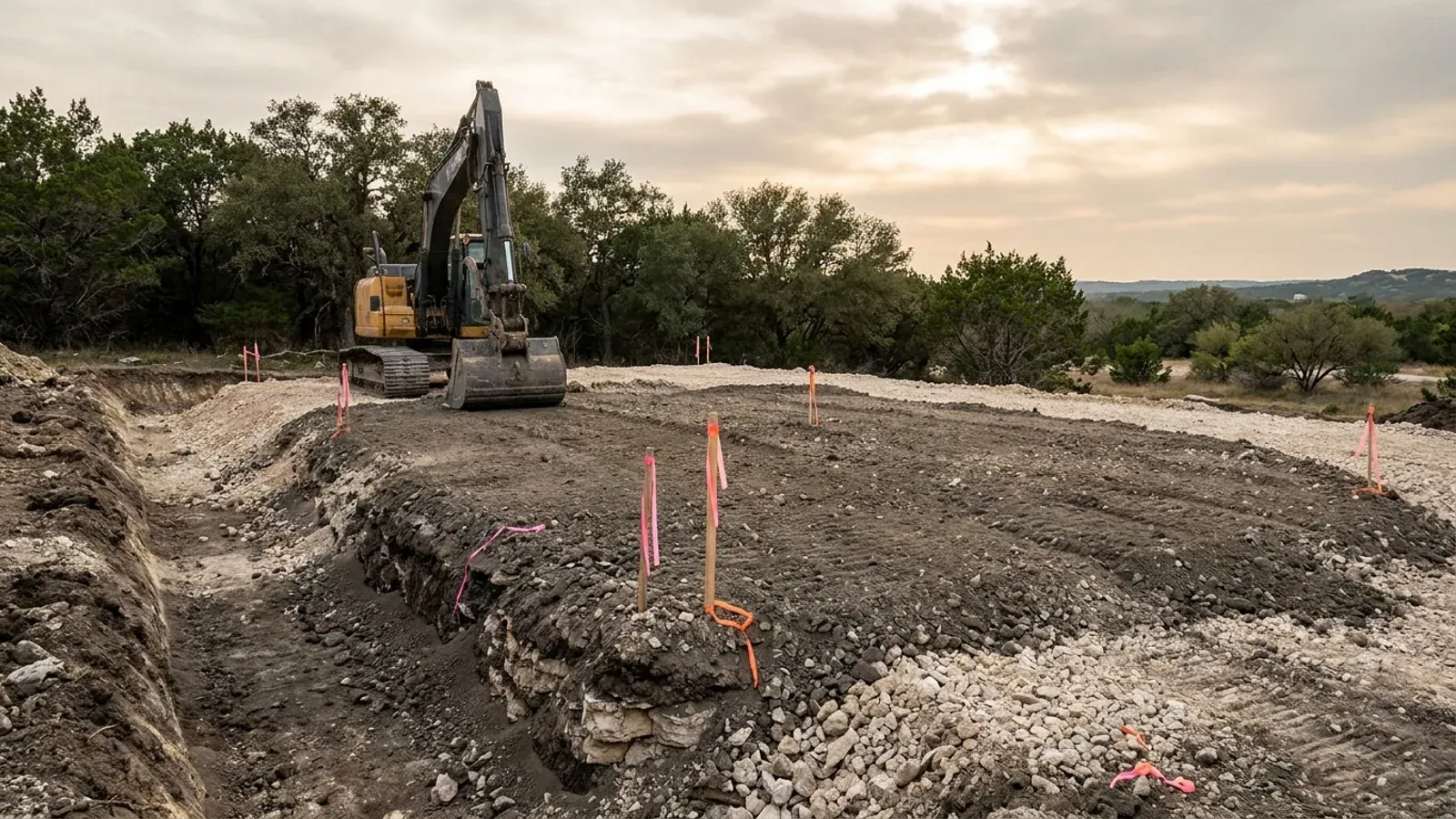
An excavator grading a compacted building pad on a cleared lot, with survey stakes and a drainage swale visible.
Below the slab

The expensive surprises are in the ground, not the building

What moves a Texas budget is usually below grade, and it is soil rather than rock: shrink-swell clay. The Blackland Prairie and the Gulf Coast clays move enough between a wet season and a dry one to drive the foundation design across the state's largest markets, which is why several DFW cities require an engineer's seal on the foundation of every new house. Those are the same conditions that decide whether a septic field passes its soil and site evaluation, so the grading plan, the foundation and the drainfield get resolved together rather than one at a time. We price the dirt before we price the building.

What we build in Round Rock

All nine of our services — kits, custom plans, post-frame and steel construction, site preparation, permitting and engineering, through to turnkey builds — are available across Williamson County. What a project costs depends far more on the parcel than on square footage, so we work from your land rather than from a rate card.

See what we build

What a build looks like

Three stages every Round Rock project passes through, from a raw parcel to a finished home. Site work first, because that is where the budget is decided.
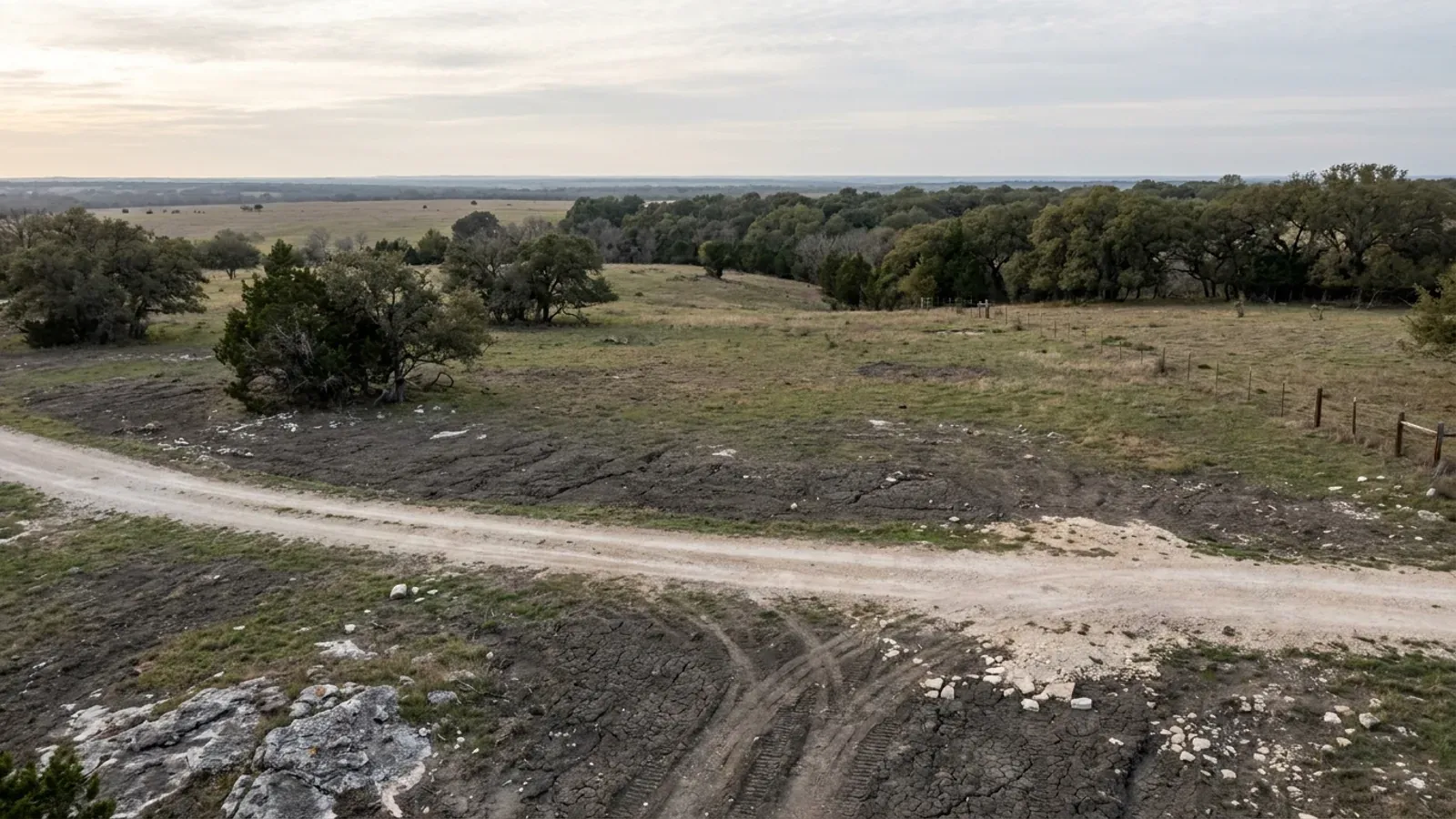
Aerial view of an undeveloped rural lot with cleared grass, a live oak and cedar elm treeline, and a pale gravel access track.
Stage one

The parcel

Zoning, setbacks, flood zone and utility access get checked before anything is drawn.

An excavator grading a compacted building pad on a cleared lot, with survey stakes and a drainage swale visible.
Stage two

Pad and permit

Clearing, grading and a compacted pad, while the submittal works through Williamson County.
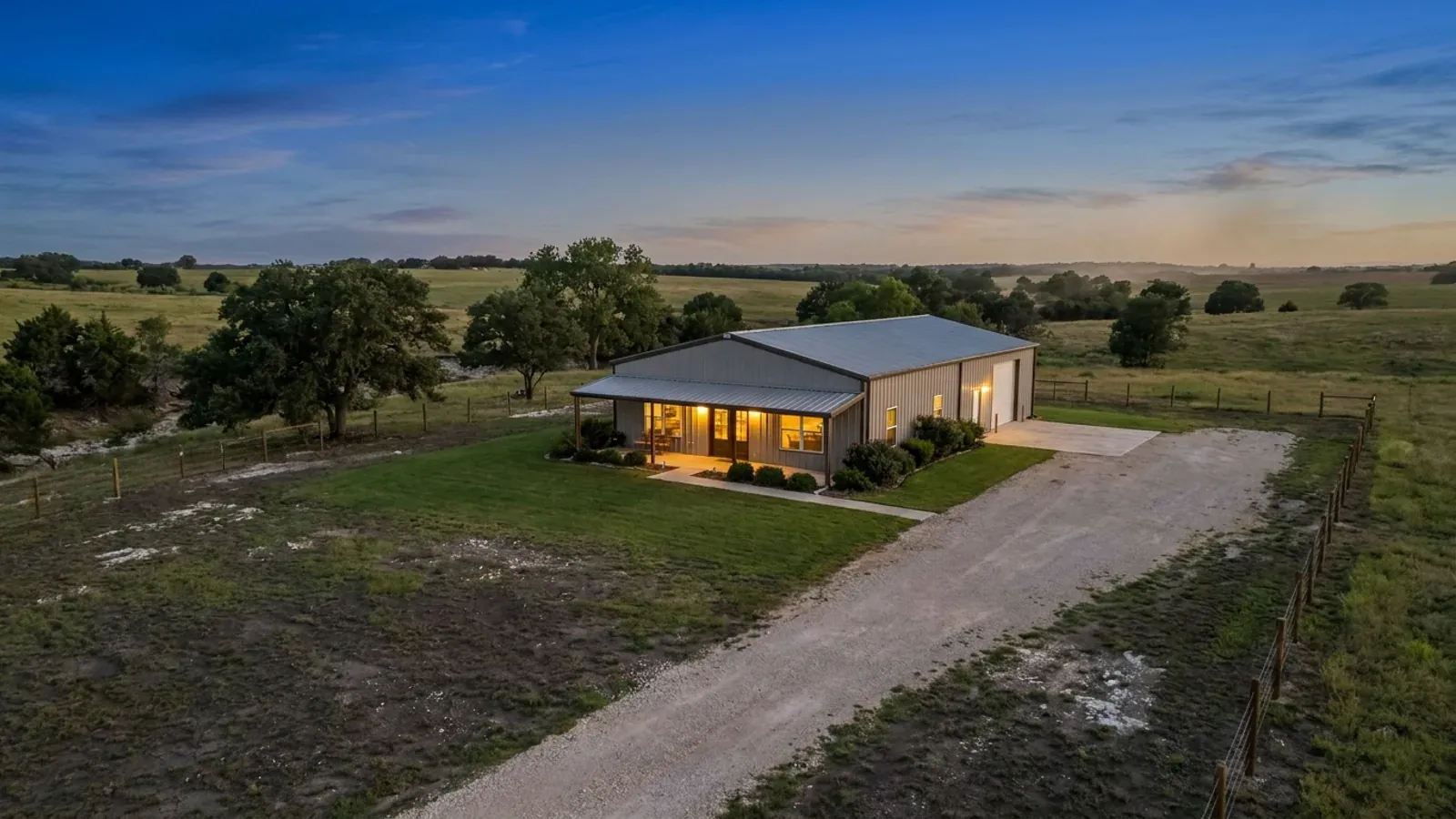
A finished barndominium at dusk with warm interior lighting glowing through its large windows.
Stage three

Frame to finish

Shell erected and dried in, then systems, insulation and interior finish through to CO.

Those are the rules for Williamson County. Tell us what you want to build and we will draw it to them.

Where we build around Round Rock

Williamson County and the rural land around it. The buildable acreage for a project this size usually sits outside the city limits, which is frequently what changes who issues your permit.

Our Round Rock service area, covering Williamson County and the surrounding rural acreage. This map marks the territory we serve, not a branch location.

Nearby areas we build in

Others we cover in this part of Texas. The permitting authority, the adopted design criteria and the zoning can all differ from one to the next.

Building in Round Rock: common questions

7 questions we get asked most often about building in Round Rock. If yours is not on the list, ask it directly.

Can I build a barndominium in Round Rock?
Honestly, on most Round Rock lots you cannot build the thing people mean by the word. The shop bay is the problem. Section 2-26 of the Zoning and Development Code caps an accessory building at 15 feet everywhere except the AG district, and the use table at section 2-25 shows AG is also the only district that permits agricultural operations. A city zoning inventory in January 2020 found zero acres of AG inside the limits and 58 acres of SF-R, the two-acre rural district. The largest minimum lot anywhere else is SF-1 at 10,000 square feet, under a quarter of an acre. A metal-framed house on a Round Rock lot is a different and perfectly buildable proposition, but the house-plus-workshop-on-land version generally is not, and the land for it is in unincorporated Williamson County, on the edges of Georgetown, or west in Burnet County.
Which building code applies in Round Rock?
The 2024 International Residential Code, including all appendices, adopted by Ordinance No. O-2025-335 on 18 December 2025 and in force from 1 January 2026. It replaced the 2015 edition, so the city moved nine years of code in one step. Only three local amendments touch the residential code and all three concern attached townhouses, which means a detached house here is built to the 2024 code essentially as published. One caution worth knowing: the city's published Code of Ordinances is codified only through June 2025 and its sections still print the 2015 editions. The ordinance is the text in force.
What is the design wind speed in Round Rock?
Round Rock does not publish one. Its adopting ordinance fills in no cell of IRC Table R301.2, so there is no city figure for wind speed, frost depth, ground snow load or seismic category. Austin publishes 105 mph and is fifteen miles down I-35, but that is a different jurisdiction on a different ordinance and its number does not carry across. What Round Rock requires instead is engineering: every new single-family application must include engineered foundation, framing and wind bracing plans and details, and the engineer's slab report is checked at the final inspection. Ask the Building Inspection Division on 512-218-5550 before anyone seals plans.
Does the Edwards Aquifer affect building in Round Rock?
It does, and it catches people. TCEQ's own mapping puts downtown Round Rock over the Edwards Aquifer Recharge Zone and the western edge of the city over the Contributing Zone, with the east side outside both. Building a private residence over either zone falls under the state's Edwards rules at 30 TAC chapter 213 unless you can show one of a short list of conditions, and the two that matter here are a lot larger than five acres with a single house on it, or staying under 20 percent impervious cover. TCEQ counts rooftops, driveways, concrete pads, sheds and sidewalks toward that 20 percent, which is exactly a house plus a shop plus an apron plus a drive. Round Rock's own zoning allows 40 percent building coverage in SF-1 and imposes no impervious cover limit at all, so the city's rules will not warn you about the state's. The TCEQ Austin regional office covers Williamson County on 512-339-2929.
What will the city charge, and how long does review take?
Round Rock publishes the numbers. The building permit fee is $485, the water meter fee on a 5/8-inch meter is $320 and the water and sewer line fee is $200. Water and wastewater impact fees are charged per living unit equivalent, and a 5/8-inch meter is one unit: on a plat recorded after 1 January 2024 that is $4,912 and $2,921. There are seven tiers going back to plats recorded before 2005 and they do not run in a straight line, so it is the recording date of your plat that decides the bill, not the year you build. A roadway impact fee applies separately, phased in from the date of final plat issuance, with no single figure. The city states review takes approximately 30 business days once an application is accepted and that expedited review is not available.
Is the soil in Round Rock the Blackland clay everyone warns about?
In the eastern third of the city, yes. Everywhere west of about the middle of town, no, and the difference matters. USDA soil mapping puts downtown and the west side on Eckrant stony clay, which has hard limestone about eleven inches down, so the foundation question there is excavation and what the slab bears on. Sample a few miles east and the mapping becomes Houston Black clay, a vertisol that is 54 percent clay with a linear extensibility of 12 running deeper than six feet, which is the shrink-swell problem in its classic form. The Balcones Escarpment runs through the city and takes the soil with it. It makes little practical difference to whether you need an engineer, because Round Rock requires an engineered foundation on every new house regardless, but it makes a great deal of difference to what that engineer designs, so get a geotechnical report for the parcel rather than for the city.
What applies just outside the city limits?
Something quite different. The Zoning and Development Code says so itself at section 1-5: the code applies to all land within the city limits. Round Rock is over 100,000 people so it carries a five-mile extraterritorial jurisdiction, but Texas courts have held that a home-rule city has no authority to enforce its building codes out there, and the city's own comprehensive plan notes it has no zoning authority inside the municipal utility districts in its ETJ. A city can still require you to plat. Round Rock does tell people that a permit is needed in the Chandler Creek and Vista Oaks municipal utility districts, so the position is not uniform across the ring, and the city's own guidance is to ring the Building Inspection Division on 512-218-5550 to establish which side of which line a given address falls on before you rely on anything.

Building in Round Rock?

Start with the plan. Tell us what you want to build and we will draw it, then confirm what Williamson County will actually let you put on the parcel and what wind load it has to meet. That conversation costs nothing.