Barndominium Builders in Georgetown, TX
Georgetown went from 68,725 people in 2020 to 106,907 in 2025, and the fair question is whether a boom like that has already eaten the acreage. It has not, but the ground is moving. The city's Agriculture district takes two acres today and five from 1 November 2026, when the first full rewrite of the development code since 2003 takes effect. What shapes a barndominium here is not lot size, though. It is two rules. A detached accessory building is held to about a quarter of the house, so workshop space at working scale has to be attached, under one roof, which is the barndominium form to begin with. And Georgetown added a section to the 2021 IRC requiring every residential foundation to be engineered and then certified by that engineer after the pour, with no opinions and no disclaimers in the certificate.
Georgetown at a glance
- County
- Williamson County
- Population
- 106,907
- Where we build
- Georgetown, Round Rock, Williamson County, Burnet County, Austin
- Site visits
- Site visits scheduled across Georgetown and the rest of Williamson County
ZIPs 78626, 78628, 78633
Building conditions in Georgetown
What actually changes from one Texas jurisdiction to the next: who issues the permit, whether the residential code is enforced there at all, what the structure has to be engineered to, and what the ground is like. These are the numbers your drawings have to satisfy.
Georgetown Code of Ordinances § 15.03.120, adding IRC Section R401.1.2 (Ord. No. 2023-43)
Georgetown Unified Development Code § 6.05.010.C, and § 7.04.010.C of the code effective 1 November 2026
Georgetown UDC § 11.07.050.F, and TCEQ, Edwards Aquifer: Private Residences; 30 TAC 213.5(h)(2); 30 TAC 213.21(b)
City of Georgetown Residential Permits page, and Unified Development Code § 1.05.020
Georgetown UDC §§ 6.02.020, 6.02.030 and Table 11.02.010.B, and §§ 7.02.020 and 7.02.030 of the code effective 1 November 2026
Georgetown Code of Ordinances §§ 13.32.061, 13.32.070 (Ord. No. 2025-40, adopted 12 August 2025)
Also worth knowing before you build in Georgetown
- The permit fee counts the shop
- A new single-family building permit in Georgetown is a $125 application fee, a permit fee of $125 plus $0.50 per square foot, and a $25 technology fee. The city's own footnote reads that square feet includes garages, porches and patios, so the shop bay and the covered porches sit inside the fee base rather than outside it. Residential plan review itself is free for buildings up to two storeys and four living units.
- Getting power to the tract
- Georgetown owns its electric utility, and on a rural connection the customer funds the line extension. The city releases a Letter of Serviceability once half the invoice is paid, gives 90 days before the estimate is revised, and states that it collects 100 percent of the invoiced project cost before acquiring materials. Some materials carry lead times of six months or more. A recorded easement for the primary route, and the trenching, conduit and transformer pads, are on the customer before the utility schedules construction.
- The geologic assessment
- For a regulated activity over the Edwards Aquifer recharge zone, Georgetown requires a geologic assessment containing everything 30 TAC 213.5 requires, plus identification of every spring and stream on the property. On a tract platted before 9 December 2014 or exempt from platting it goes in with the building permit, and no application may be approved until the Development Engineer accepts it. A notarised acknowledgement form goes in alongside, and the application is incomplete without one. The rules apply in the city and the extraterritorial jurisdiction alike.
- Impervious cover in the ETJ
- Out in the extraterritorial jurisdiction the cap turns on wastewater rather than on zoning, because there is no zoning. A single-family build without public wastewater service is held to forty percent impervious cover, and forty-five percent with it, whether or not the tract sits over the Edwards Aquifer. House, shop apron, drive and any barn all count toward it, which on a small tract on septic is the number to check before anything else.
- Do your own trade work
- Georgetown added a homestead exemption permit to the 2021 IRC. An unlicensed person may do plumbing, electrical or mechanical work in a dwelling they own if they file an affidavit with the Building Official that it is their homestead, intend to occupy it, and can show proof from the Williamson County appraisal district. One such permit per person per twelve months, at one location, and nobody else may work under it.
- The insulation escape hatch
- Georgetown runs the 2021 IECC, and amended it with a line that matters for a metal roof over an open ceiling: where the R-49 requirement cannot be met, the total UA alternative must be used instead, calculated in the ResCheck form the city requires at permit submission. Williamson County sits in climate zone 2A on both the older and the current maps, so the insulation answer here does not move with the code edition the way it does in Dallas or Fort Worth.
- Guest quarters and second dwellings
- An accessory dwelling unit is limited to fifty percent of the primary dwelling and no more than 1,000 square feet, needs three on-site parking spaces, and must stay on the same electric and water meters as the main house. In the Agriculture district there is a separate allowance: one additional primary dwelling for every 30 acres, restricted to an agricultural employee, caretaker, family or guests of the owner.
- Growth, and where it went
- Georgetown grew from 68,725 people in 2020 to 106,907 in 2025, a 55.6 percent rise across 58.9 square miles of land. That works out at roughly 1,814 people per square mile, a suburban figure, and most of the growth arrived as platted subdivisions. The acreage that is left sits in the AG and RE districts and in the extraterritorial jurisdiction rather than inside the new neighbourhoods.
City of Georgetown Construction Fee Schedule, revised 12 June 2026, per Resolution RES 092722-D
City of Georgetown Electric Line Extension page; policy approved 28 October 2025, effective 1 July 2026
Georgetown UDC §§ 11.07.010, 11.07.050 and 11.07.060, deriving from Ordinance 2015-14 of 24 February 2015
Georgetown Unified Development Code § 11.02.010.C
Georgetown Code of Ordinances § 15.03.060, adding IRC Section R105.1.2 (Ord. No. 2023-43)
Georgetown Code of Ordinances § 15.14.040 (Ord. No. 2023-43), and the city's residential submittal requirements
Georgetown Unified Development Code § 6.02.010.B, sections 4 and 5 of the code effective 1 November 2026
U.S. Census Bureau Vintage 2025 sub-county population estimates and 2025 place gazetteer
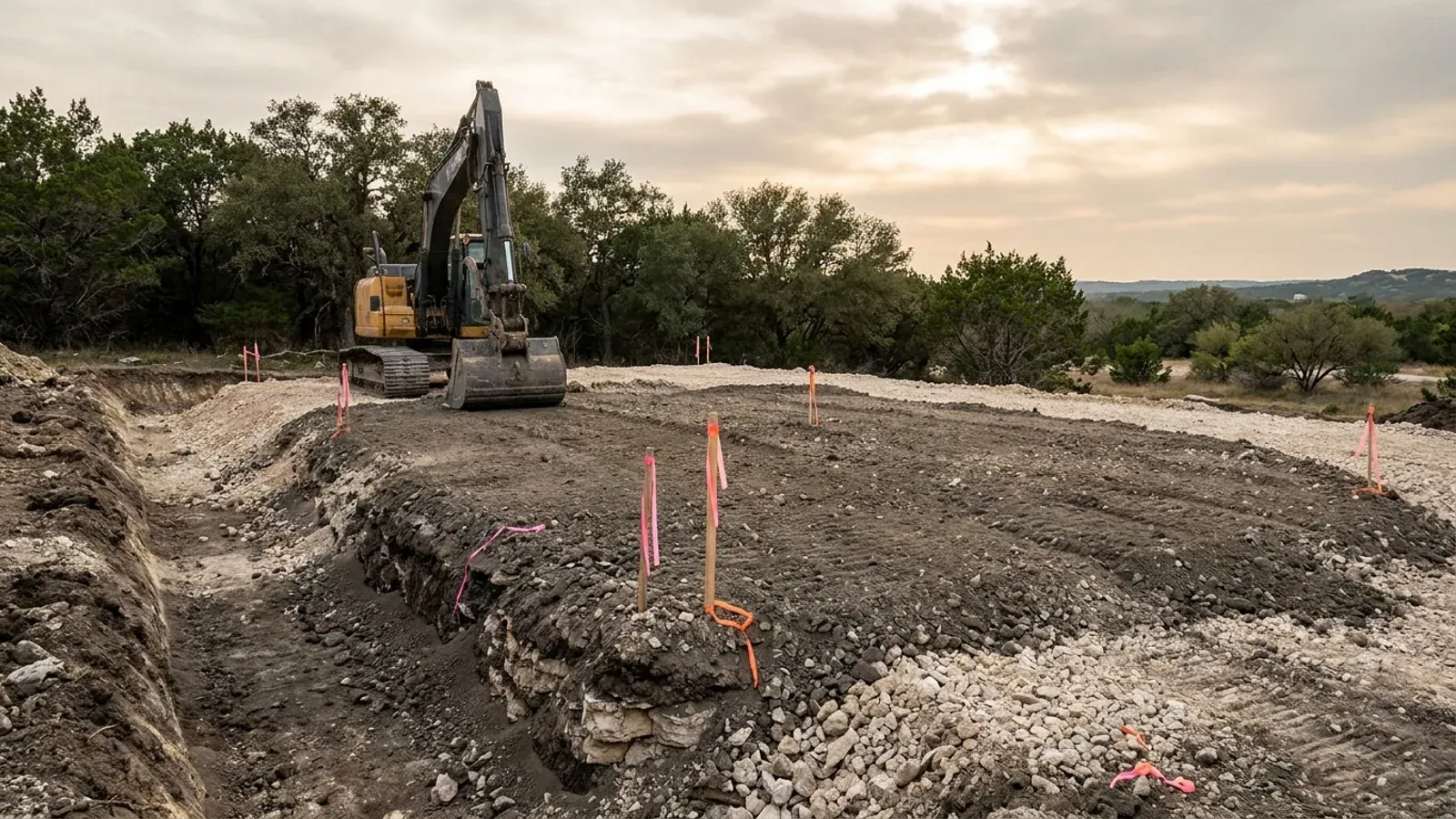
The expensive surprises are in the ground, not the building
What moves a Texas budget is usually below grade, and it is soil rather than rock: shrink-swell clay. The Blackland Prairie and the Gulf Coast clays move enough between a wet season and a dry one to drive the foundation design across the state's largest markets, which is why several DFW cities require an engineer's seal on the foundation of every new house. Those are the same conditions that decide whether a septic field passes its soil and site evaluation, so the grading plan, the foundation and the drainfield get resolved together rather than one at a time. We price the dirt before we price the building.
What we build in Georgetown
All nine of our services — kits, custom plans, post-frame and steel construction, site preparation, permitting and engineering, through to turnkey builds — are available across Williamson County. What a project costs depends far more on the parcel than on square footage, so we work from your land rather than from a rate card.
See what we buildWhat a build looks like
Three stages every Georgetown project passes through, from a raw parcel to a finished home. Site work first, because that is where the budget is decided.
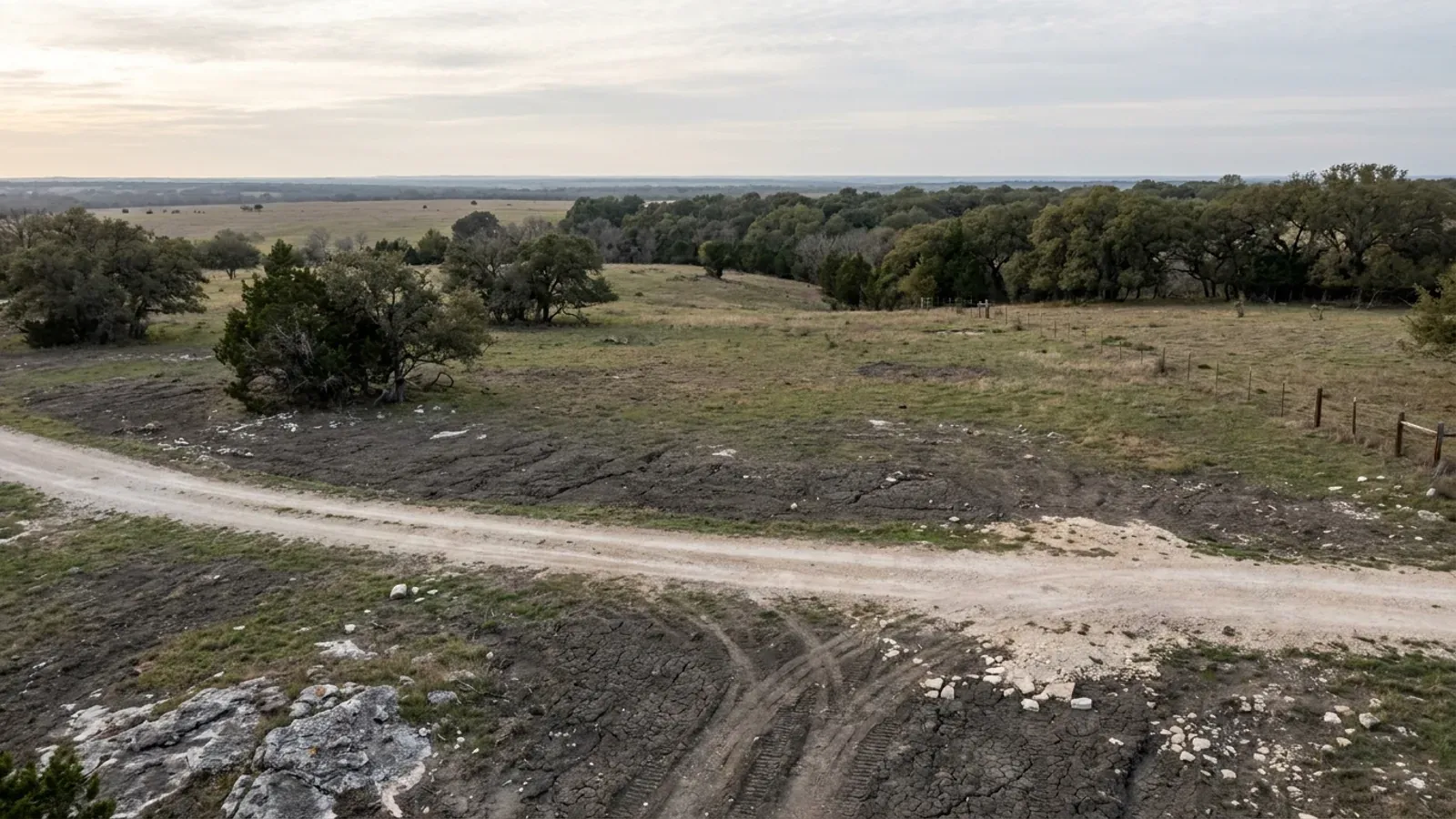
The parcel
Zoning, setbacks, flood zone and utility access get checked before anything is drawn.
Pad and permit
Clearing, grading and a compacted pad, while the submittal works through Williamson County.
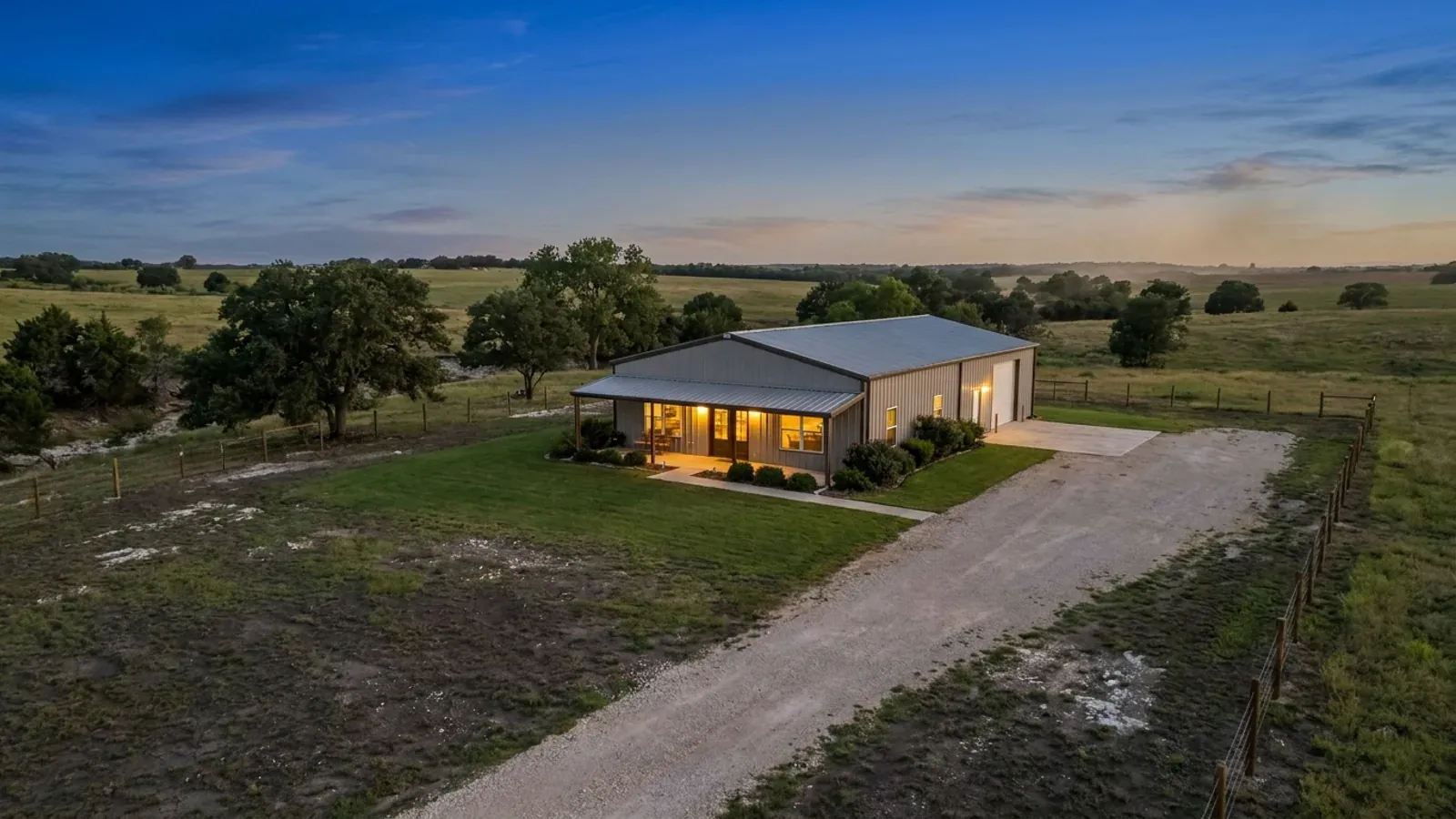
Frame to finish
Shell erected and dried in, then systems, insulation and interior finish through to CO.
Those are the rules for Williamson County. Tell us what you want to build and we will draw it to them.
Where we build around Georgetown
Williamson County and the rural land around it. The buildable acreage for a project this size usually sits outside the city limits, which is frequently what changes who issues your permit.
Keep reading
The questions that usually come next once you know what Georgetown allows.
Barndominium Cost Guide
Sourced per-square-foot ranges by tier and by size, with a calculator built on the same figures.
Read itIs It Legal in Texas?
Classification, zoning, the HOA gate, and why "nonresidential farm building" does not cover a home.
Read itHow Long Does It Take?
Census build-duration data, and what actually sets the permit clock where you are building.
Read itNearby areas we build in
Others we cover in this part of Texas. The permitting authority, the adopted design criteria and the zoning can all differ from one to the next.
Building in Georgetown: common questions
7 questions we get asked most often about building in Georgetown. If yours is not on the list, ask it directly.
Can I put a barndominium on a lot inside Georgetown city limits?
My land is outside the city limits. Do I still need a Georgetown building permit?
What does the Edwards Aquifer recharge zone mean for building here?
Does Georgetown require an engineer for the foundation?
How long does Georgetown take to review a house plan, and what will the city charge?
Why does it matter when my lot was platted?
How do I get electricity to a rural tract in Georgetown's service area?
Building in Georgetown?
Start with the plan. Tell us what you want to build and we will draw it, then confirm what Williamson County will actually let you put on the parcel and what wind load it has to meet. That conversation costs nothing.