Barndominium Builders in Williamson County, TX
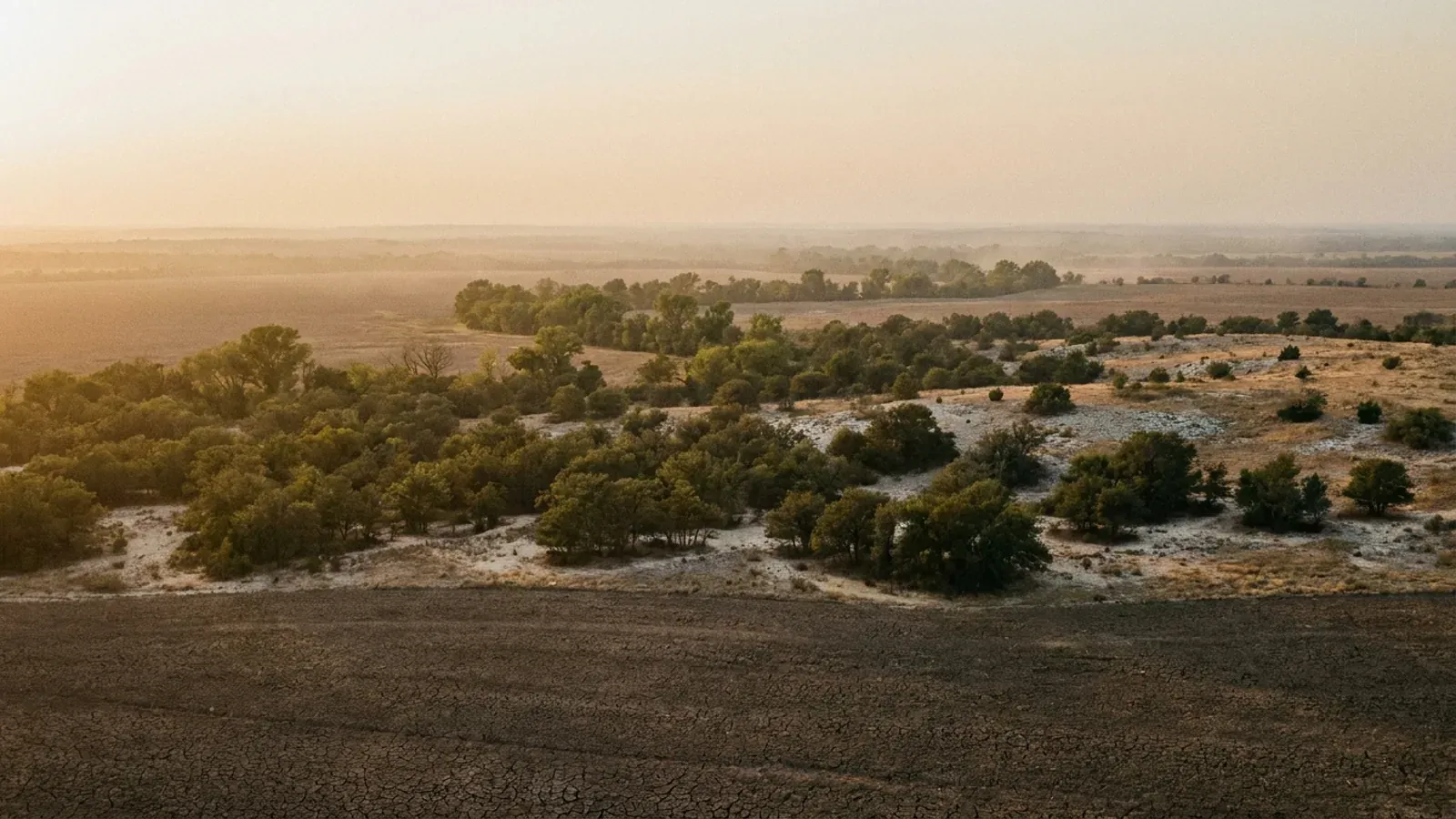
Williamson County has no residential building code, and the county says so in its own words: it has never adopted an order applying Subchapter F of Local Government Code chapter 233. There is no county building permit, no county fee and no county inspector for a house. What the county does require is a Certificate of Compliance on every structure outside the floodplain, a septic permit on a tract of any size, and a platting answer before either of those. The ground splits at the Balcones Escarpment. West of I-35, toward Liberty Hill, Leander and Georgetown, it is limestone, thin soil over rock and the Edwards Aquifer recharge zone, where TCEQ has a say the county does not. East toward Taylor, Granger and Coupland it is Blackland Prairie clay, and the county's own pavement tables run the plasticity index to 55. Two grounds, one county, and the acreage sits at both ends.
Williamson County at a glance
- County
- Williamson County
- Population
- 752,827
- Where we build
- Georgetown, Round Rock, Bell County, Burnet County
- Site visits
- We meet you on the tract, Georgetown or anywhere else in Williamson County
ZIPs 78626, 78628, 78633, 78641, 78642, 78613, 78664, 78665 and more
Building conditions in Williamson County
What actually changes from one Texas jurisdiction to the next: who issues the permit, whether the residential code is enforced there at all, what the structure has to be engineered to, and what the ground is like. These are the numbers your drawings have to satisfy.
Williamson County, Infrastructure — Developers FAQ, "Does Williamson County issue a certificate of occupancy?", dated 25 October 2023 — wilcotx.gov/faq.aspx?TID=73
Williamson County Flood Damage Prevention Order, Articles 3 and 6 — wilcotx.gov/DocumentCenter/View/3244; Williamson County Floodplain Management — wilcotx.gov/652/Floodplain-Management
Order Adopting Rules of Williamson County, Texas for On-Site Sewage Facilities, adopted 12 January 2021, sections 10(A)(3) and 10(E)(10) — wilcotx.gov/DocumentCenter/View/3109
Williamson County On-Site Sewage Facilities Order, section 10(D)(2) — wilcotx.gov/DocumentCenter/View/3109; Williamson County Subdivision Regulations, 4 March 2025, Appendix F1 — wilcotx.gov/DocumentCenter/View/15640
30 TAC 213.5(h)(2); TCEQ, Edwards Aquifer: Private Residences, last modified 17 February 2026 — tceq.texas.gov/permitting/eapp/edwards-aquifer-private-residences; TCEQ Edwards Aquifer Protection Program — tceq.texas.gov/permitting/eapp
Williamson County On-Site Sewage Facilities Order, section 10(B) — wilcotx.gov/DocumentCenter/View/3109; TCEQ preamble to the 2023 amendment of 30 TAC 285.3(f)(2)
Also worth knowing before you build in Williamson County
- A tract divided the wrong way cannot get a septic authorisation
- Section 10(D)(3) of the septic order is one sentence long and it can foreclose a build: "A tract that has been subdivided without compliance with the Williamson County Subdivision regulations will be ineligible to obtain an authorization to construct an on-site sewage facility." No septic authorisation means no house. The county's platting exemptions are real but they are paperwork, not silence: Appendix A3.2 of the subdivision regulations requires every exemption to be "approved in writing by the County Engineer prior to the division of the property," supported by an affidavit setting out the detailed basis for the exclusion, subject to penalties of perjury, plus copies of the deeds. Two dates matter. A tract whose boundary has not changed since 21 February 1985 may be sold entire without platting, and a property fronting a public street whose boundary has not changed since 1 February 2000 is a legal lot.
- There is a county fire code, and the appraisal district decides if it reaches you
- Williamson County passed the 250,000 population bracket in Local Government Code section 233.061 and adopted the 2018 International Fire Code, which the Fire Marshal's office dates to 10 November 2020. Its scope at section 2.4(A) is unusually worded: it applies to "all public buildings, commercial establishments, and multi-family dwellings with four or more units, as determined by the current property designation identified by the Williamson Central Appraisal District." The county's own FAQ answers more bluntly — all commercial structures in the unincorporated areas. A house you live in is none of those, and section 1.1(B) confirms the fire code "is not intended to be a building code." But the trigger is the appraisal roll, and section 3.7(B) treats "a change in occupancy classification involving a change in the purpose or level of activity in a building, including the renovation of a warehouse into a loft apartment" as a substantial improvement. Anyone planning to let the building should settle its classification with the appraisal district before framing, not after.
- Only three per cent of the county's growth went to unincorporated land
- Williamson County grew from 615,611 in 2020 to 752,827 in 2025, an increase of 137,216 people. The balance of the county — everyone outside every city limit — went from 189,898 to 194,323, absorbing 4,425 of them, about three per cent. Everything else went into a city. Georgetown grew 55.6 per cent, Hutto 63.9, Leander 52.7, and Liberty Hill 261.9 and Jarrell 228.9 as their limits pushed outward. Cedar Park grew 2.5 per cent and is finished. At the eastern end Granger grew 3.6 per cent, Bartlett 4.2, Florence 4.4, Coupland 5.5 and Thrall 7.7 — the farm towns are static, and that is where the land is quietest.
- About 219 people per square mile of unincorporated land
- Williamson County covers 1,115.869 square miles of land. Roughly 230 of those, about 21 per cent, sit inside a city limit once the seven cities that straddle a county line are counted only for their Williamson share. That leaves about 886 square miles carrying 194,323 people, or around 219 to the square mile — at typical household size, roughly one house per eight acres. That is not open ranch country and it is not suburbia either. Seventeen city extraterritorial jurisdictions reach across much of it, and the county publishes a map and a contact list because who reviews your plat depends on which one you are standing in.
- No groundwater district permits your well here — and that is not good news
- Williamson County has no groundwater conservation district. The county publishes the position itself: "Williamson and Travis counties are surrounded by groundwater conservation districts: Clearwater WCD north of us in Bell County; Post Oak Savannah GCD to the east in Milam County; Central Texas GCD west in Burnet County ... Travis and Williamson counties are islands in the middle of regional water conservation efforts." The same piece notes that most western Williamson wells draw on the Trinity Aquifer, which recharges at only four to five per cent of rainfall, and that the county is oversubscribed to groundwater west of Interstate 35. So nobody spaces, studies or manages the next well drilled next door. A licensed driller and a State of Texas well report are still required, and where a subdivision is supplied by groundwater the county requires a licensed engineer or geoscientist to certify adequate supply under 30 TAC chapter 230.
- TCEQ can stop your dozer on land with no building permit
- On the Edwards recharge or transition zone, TCEQ's rule is that "If you discover any sensitive feature during construction, replacement, or rehabilitation, immediately suspend all regulated activities near it, and notify TCEQ," and that "Neither construction nor soil-disturbing activities may proceed until TCEQ has reviewed and approved the methods proposed to protect the feature." A sensitive feature is a permeable geologic or artificial feature where surface water can reach the aquifer quickly — a cave, a solution cavity, a sinkhole. A Texas-licensed engineer or geoscientist prepares a protection plan and TCEQ has a week to review it; meanwhile no activity should typically occur within fifty feet. The number to call for Williamson County is 512-339-2929. That is a state stop-work power on a parcel where the county issues no building permit at all.
- The county's own pavement tables describe both halves of the ground
- Section B4.4 of the subdivision regulations tells a geotechnical engineer that "Borings shall be to a depth of ten ft or, if solid rock is encountered, one ft below non-fractured rock or 3 ft below fractured rock," and that the soils report must carry the subgrade plasticity index. Section B4.5 then bands the pavement design by that index: under 20 for clayey sand, 20 to under 35 for lean clay, and 35 to 55 for fat clay, with lime-treated subgrade from 20 upward. One county document covers hitting rock and reaching a plasticity index of 55 — the Balcones Escarpment, written into a pavement table. The septic side says the same at house scale: the two site evaluation holes are dug five feet deep "or to a solid rock layer."
- Twenty per cent impervious cover matters twice, for two different reasons
- TCEQ's Edwards rule lets a single-family residence skip an individual aquifer plan at 20 per cent impervious cover or less. Separately, Appendix B11.1 of the county's subdivision regulations waives on-site stormwater detention for "Plats with three or less lots for single family residential use, with less than 20% impervious cover per lot" and for "Plats with all lots of 2 acres or more and less than 20% of impervious cover per lot." The county defines impervious cover at section 2.22 as roads, driveways, parking areas, concrete, sidewalks, structures and buildings; TCEQ's list is rooftops, driveways, concrete pads, sheds and sidewalks. Two agencies, two definitions, the same threshold — and a plat note reserves a maximum percentage per lot on the face of the plat itself.
- The county signs an Edwards Aquifer certification on every plat
- Section 5.31 of the subdivision regulations requires a signature block in which the County Engineer certifies that the plat complies with "the Williamson County On-Site Sewage Facility Regulations, Construction Standards for On-Site Sewage Facility Regulations as published by the Texas Commission on Environmental Quality (TCEQ), and regulations of the Edwards Aquifer, Chapter 213 Subchapter A, Section 213.1 to 213.14 of the Texas Administrative Code, as amended," and it must be signed before final plat approval. The county's septic order gives the reason in its preamble: the Commissioners Court found "that the Edwards Aquifer is a vital source of drinking water for residents of Williamson County and the Edwards Aquifer has been identified as being susceptible to groundwater pollution." A county with no building code still puts its engineer's name to an aquifer certification.
- The county is the septic agent for the whole county, cities included
- TCEQ's authorised agent register returns two records for Williamson County: "WILLIAMSON COUNTY AUTHORIZED AGENT — entire County" and the TCEQ Austin regional office. No city in the county is separately listed, and TCEQ's own results page prints the rule for reading that: "Do you live within the limits of a city? Find the name of the city under the Authorized Agent column. If the city is not listed, contact the county." So septic inside Georgetown, Round Rock, Cedar Park, Leander, Hutto, Taylor, Liberty Hill and Jarrell is the county's programme, run by the County Engineer's Office at 3151 SE Inner Loop in Georgetown. The county's own septic page names the single exception: it regulates septic throughout Williamson County "except for those areas that are located within the City of Austin."
Williamson County On-Site Sewage Facilities Order, section 10(D)(3); Williamson County Subdivision Regulations adopted 4 March 2025, Appendices A2 and A3 — wilcotx.gov/DocumentCenter/View/15640
Williamson County Fire Code, Second Edition, sections 1.1, 2.4 and 3.7 — wilcotx.gov/DocumentCenter/View/1928; Williamson County Fire Marshal FAQ — wilcotx.gov/faq.aspx?TID=37
U.S. Census Bureau Vintage 2025 population estimates, co-est2025-alldata.csv and sub-est2025.csv, computed on POPESTIMATE2020
U.S. Census Bureau 2025 Gazetteer county and place files (GEOID 48491, land area 1,115.869 sq mi) with Vintage 2025 population estimates; Williamson County ETJ Map and Platting Authority Contacts — wilcotx.gov/DocumentCenter/View/3110
Williamson County News Flash, "Why the county needs a groundwater conservation district", 16 March 2023 — wilcotx.gov/CivicAlerts.aspx?AID=42; Williamson County Subdivision Regulations sections 4.19 and 5.39
TCEQ, Edwards Aquifer: Sensitive Features Encountered During Construction — tceq.texas.gov/permitting/eapp/sensitive-features-encountered-during-construction; 30 TAC 213.3(29)
Williamson County Subdivision Regulations adopted 4 March 2025, sections B4.4 and B4.5 — wilcotx.gov/DocumentCenter/View/15640; Williamson County OSSF Guide — wilcotx.gov/DocumentCenter/View/16734
TCEQ, Edwards Aquifer: Private Residences; Williamson County Subdivision Regulations adopted 4 March 2025, sections 2.22, B11.1 and Appendix C10.8 — wilcotx.gov/DocumentCenter/View/15640
Williamson County Subdivision Regulations adopted 4 March 2025, section 5.31 — wilcotx.gov/DocumentCenter/View/15640; Williamson County On-Site Sewage Facilities Order, preamble — wilcotx.gov/DocumentCenter/View/3109
TCEQ On-Site Sewage Facility authorised agent search, county code 246 — tceq.texas.gov/permitting/ossf/aa_search.html; Williamson County On-Site Sewage Facilities — wilcotx.gov/644/On-Site-Sewage-Facilities-OSSF
The expensive surprises are in the ground, not the building
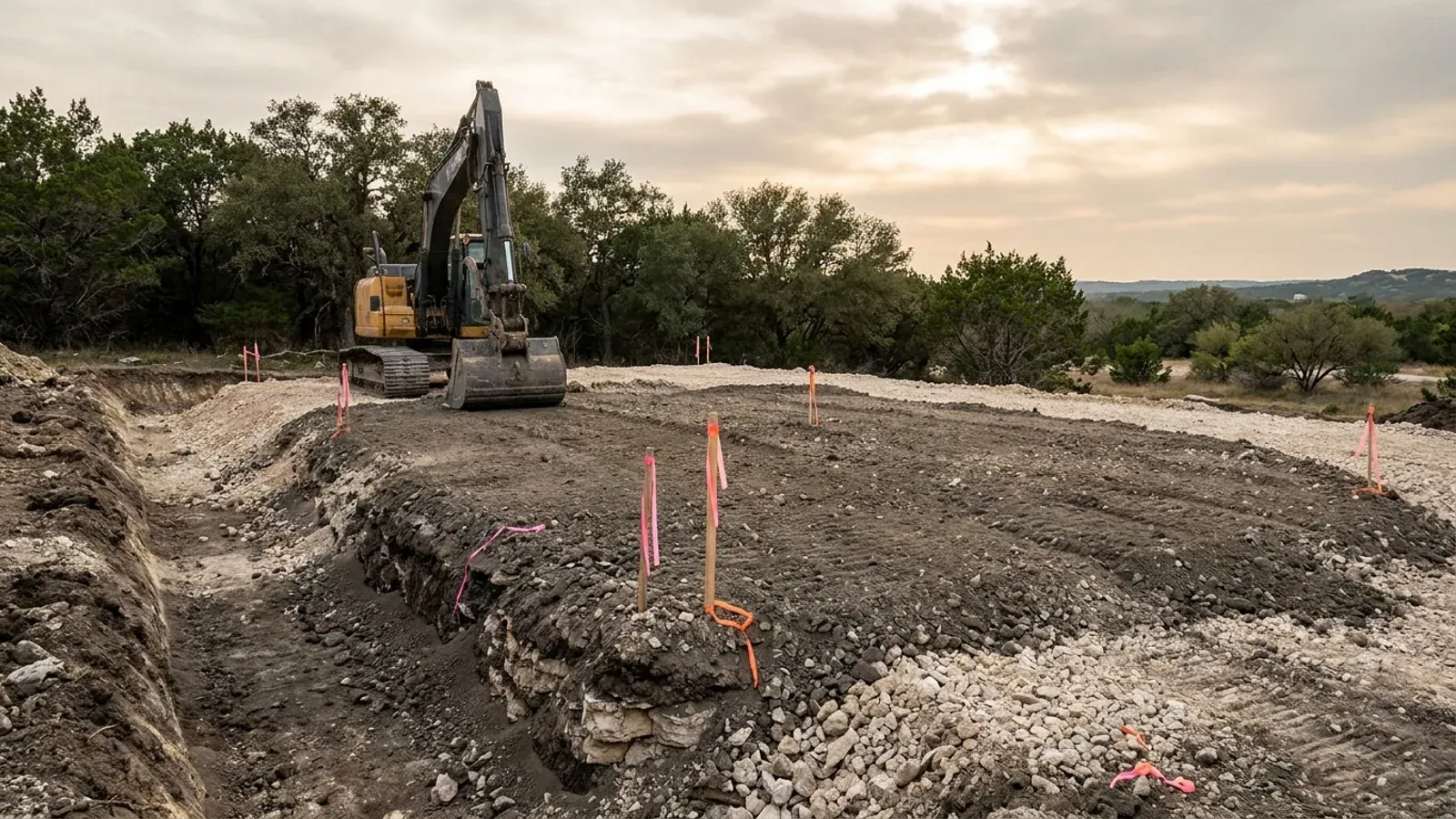
What moves a Texas budget is usually below grade, and it is soil rather than rock: shrink-swell clay. The Blackland Prairie and the Gulf Coast clays move enough between a wet season and a dry one to drive the foundation design across the state's largest markets, which is why several DFW cities require an engineer's seal on the foundation of every new house. Those are the same conditions that decide whether a septic field passes its soil and site evaluation, so the grading plan, the foundation and the drainfield get resolved together rather than one at a time. We price the dirt before we price the building.
What we build in Williamson County
All nine of our services — kits, custom plans, post-frame and steel construction, site preparation, permitting and engineering, through to turnkey builds — are available across Williamson County. What a project costs depends far more on the parcel than on square footage, so we work from your land rather than from a rate card.
See what we buildWhat a build looks like
Three stages every Williamson County project passes through, from a raw parcel to a finished home. Site work first, because that is where the budget is decided.
The parcel
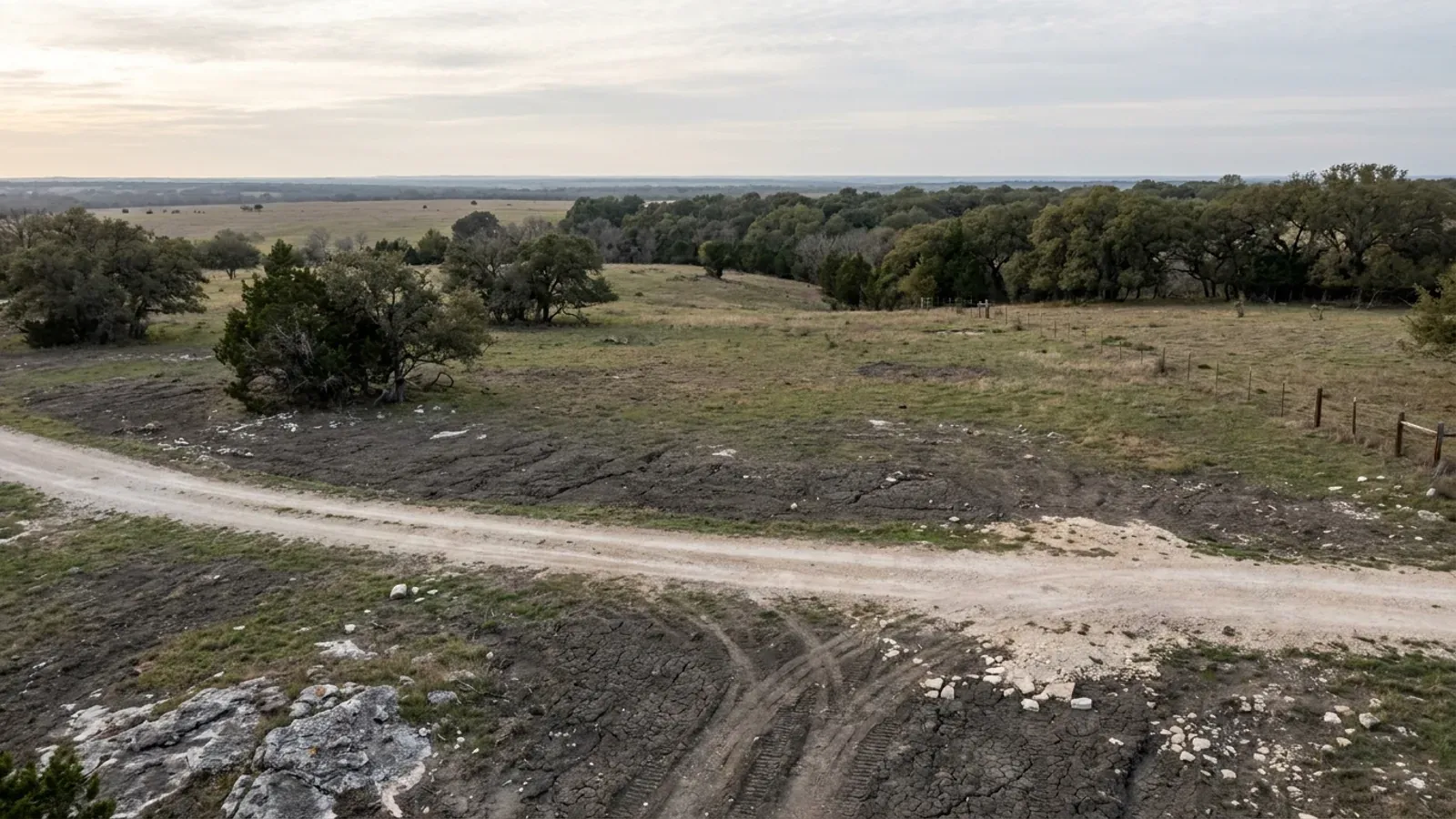
Zoning, setbacks, flood zone and utility access get checked before anything is drawn.
Pad and permit
Clearing, grading and a compacted pad, while the submittal works through Williamson County.
Frame to finish
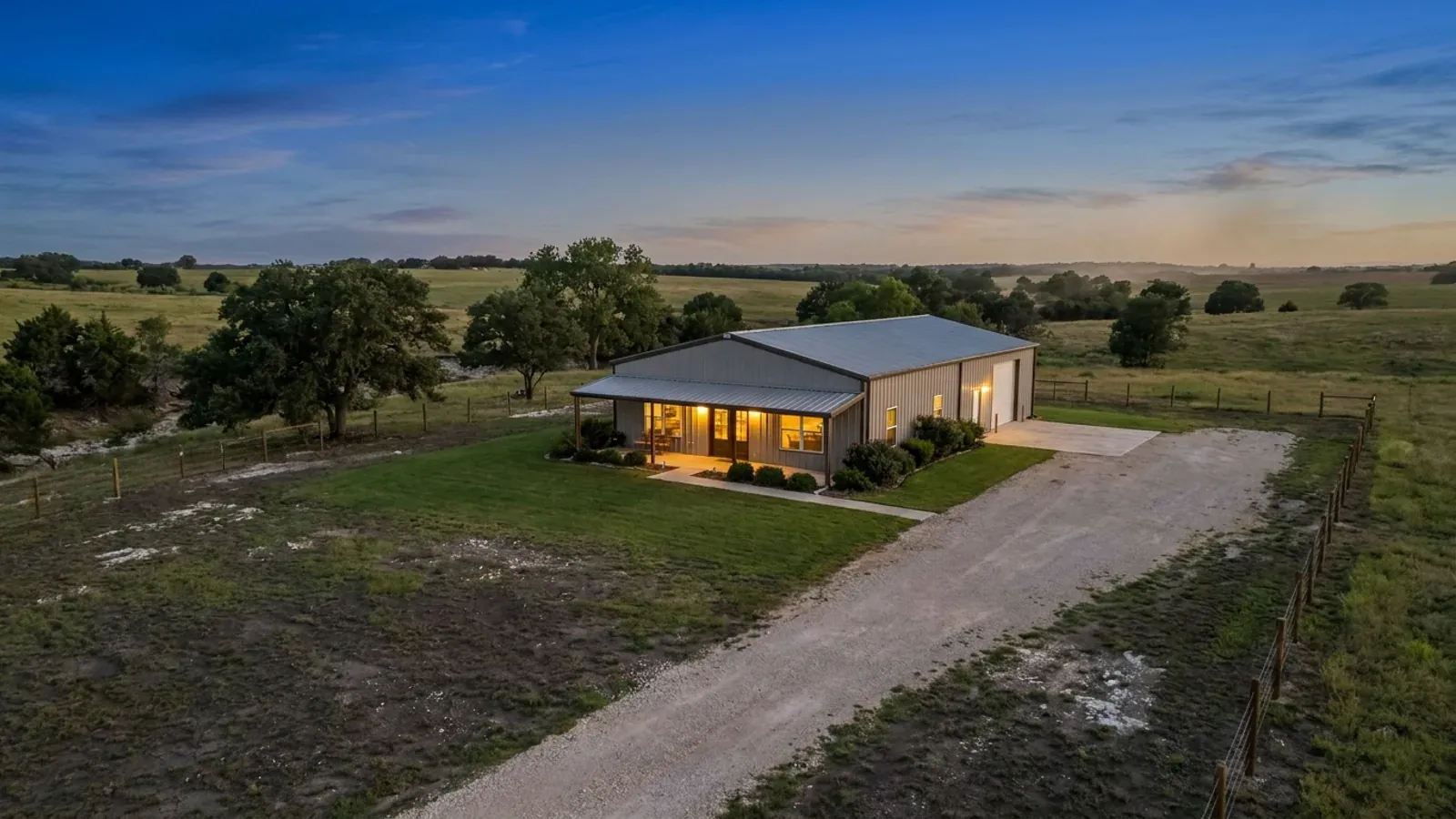
Shell erected and dried in, then systems, insulation and interior finish through to CO.
Those are the rules for Williamson County. Tell us what you want to build and we will draw it to them.
Where we build around Williamson County
Williamson County and the rural land around it. The buildable acreage for a project this size usually sits outside the city limits, which is frequently what changes who issues your permit.
Keep reading
The questions that usually come next once you know what Williamson County allows.
Barndominium Cost Guide
Sourced per-square-foot ranges by tier and by size, with a calculator built on the same figures.
Read itIs It Legal in Texas?
Classification, zoning, the HOA gate, and why "nonresidential farm building" does not cover a home.
Read itHow Long Does It Take?
Census build-duration data, and what actually sets the permit clock where you are building.
Read itNearby areas we build in
Others we cover in this part of Texas. The permitting authority, the adopted design criteria and the zoning can all differ from one to the next.
Building in Williamson County: common questions
9 questions we get asked most often about building in Williamson County. If yours is not on the list, ask it directly.
Do I need a building permit for a barndominium in unincorporated Williamson County?
Does the shop half of the building make my septic system bigger?
How much land do I need for a septic system here?
Is the Edwards Aquifer really an issue this far north?
Will I need a permit for a water well?
Where in the county is there actually land to build on?
Does the ground change across the county?
Does it change anything if I rent the barndominium out?
What is a Certificate of Compliance, and why have I been told two different things about it?
Building in Williamson County?
Start with the plan. Tell us what you want to build and we will draw it, then confirm what Williamson County will actually let you put on the parcel and what wind load it has to meet. That conversation costs nothing.